


 1 Photo
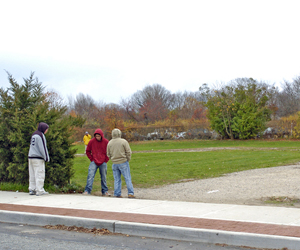
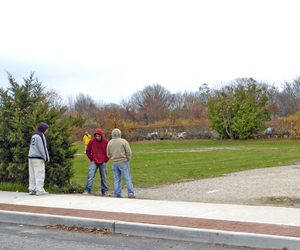
The Appellate Division of the New York State Supreme Court last week reversed a decision prohibiting day laborers from congregating at a preserved parkland site on Aldrich Lane in Southampton Village while looking for work each morning.
The appellate court’s decision, rendered on November 17, lifted the temporary injunction issued by a Suffolk County Supreme Court last year that forbade the use of Aldrich Park as a hiring site for day laborers, as the village had proposed. As a result of the ruling, the laborers are free to gather at the park and negotiate daily employment, at least until a lawsuit over the matter filed by neighbors of the site is settled. That lawsuit is currently in Suffolk County Court in Riverhead.
Southampton Village Mayor Mark Epley said the village no longer has any specific plans for using the parcel, known as Aldrich Park, as a formal hiring site.
Southampton Town and Southampton Village jointly purchased the 6-acre park in 2001 with Community Preservation Fund money, and, six years later, Mr. Epley had proposed using the vacant property next to the 7-Eleven at the corner of North Sea Road and Aldrich Lane as an open-air hiring site for day laborers, utilizing a U-shaped driveway. The village was planning to make it illegal for day laborers to solicit employment on North Sea Road and surrounding arteries as a way to shepherd the men to the park. No buildings were planned, although the mayor had suggested that portable bathrooms and benches might be added to the site, and in April 2007 village crews planted bushes to screen the site from the street. The mayor maintained that the cost of the work would be covered by donations.
The plaintiffs in the lawsuit, a group of three homeowners on Aldrich Lane, asked the Supreme Court to stop Aldrich Park from being used as a hiring site while their lawsuit was pending. The Supreme Court first granted their request, but a Manhattan advocacy firm called LatinoJustice intervened on behalf of two unnamed day laborers and worked to have that initial decision overturned.
“We’re delighted,” said Ghita Schwarz, an attorney at LatinoJustice, which was formerly known as the Puerto Rican Legal Defense and Education Fund. “The courts made the only decision that it could.”
The crux of the initial lawsuit filed by the Aldrich Lane homeowners—whether or not it was illegal for Southampton Village to use property purchased with Community Preservation Funds as anything but a public park—was not resolved in the Appellate Division, Ms. Schwarz noted. That matter still lies in the hands of justices at the Suffolk County Supreme Court in Riverhead.
Anton Borovina, an attorney at Borovina & Marullo, PLLC in Melville, who is representing three families who live on Aldrich Lane, said that the appellate court lifted the injunction because his clients did not show that they would be “irreparably harmed” if the village went forward with its hiring site plans.
“My client failed to show irreparable injury caused by allowing these people to congregate,” said Mr. Borovina.
Mr. Borovina, however, disagreed with the Appellate Division’s decision, and maintained that the parcel will lose its qualities as a park if it is used as a place to link employers and day laborers. “It is ridiculous to suggest that a park, once converted to commercial use by the snap of a finger, can be reverted back to park use,” he said.
Mr. Borovina said that he will discuss the options for fighting the Appellate Division’s decision with the three families. He declined to state what options lie before them.
Ms. Schwarz said that there is nothing she can do for the case until the homeowners make a move in Suffolk County Supreme Court.
LatinoJustice was founded in 1972 by three Latino attorneys who wanted to fight for equality for South and Central Americans living in the United States. The advocacy group began representing two day laborers who frequently obtain work on North Sea Road in 2007. The day laborers are referred to as “John Doe No. 1” and “John Doe No. 2” in the lawsuit to protect their identities, Ms. Schwarz said.
“They’re protected because there is an enormous inflamed atmosphere in the park,” Ms. Schwarz said. “There were protesters yelling scary threats at the day laborers, activists and nuns, who were also getting called offensive names.
“The park has a history of violence and fear, and we wanted to make sure the laborers who were so brave to come forward weren’t going to be intimidated by vigilante groups,” she continued.
Another portion of the appellate division’s decision involved whether or not LatinoJustice would be allowed to represent a migrant worker’s rights group called Coalition for a Worklink Center, and other individual activists. The Appellate Division is only permitting LatinoJustice to intervene on behalf of the two unnamed day laborers because the coalition and the other activists do not have a vested interest in the lawsuit, Ms. Schwarz explained.
The attorney for Southampton Village, Richard DePetris, who is representing the municipality in this matter, said that the appellate court’s decision supports the village’s stance on how free speech is involved in the matter. The village maintains that forbidding day laborers to solicit work in Aldrich Park is a violation of day laborer’s First Amendment right to free speech. The panel of judges that heard the case in the Appellate Division agreed with that position, Mr. DePetris explained.
Mr. Epley, however, said that he has not been actively working on making a portion of Aldrich Park a hiring site. He said that he has reached out to Southampton Town Supervisor-elect Anna Throne-Holst about the possibility of organizing a hiring site at the park. He has not broached the topic with the current Village Board.
“We haven’t talked about it,” he said.


 Joseph Shaw, Executive Editor on Nov 30, 2009