


 1 Photo
NULL
Fifteen years ago, the Westhampton Beach School District’s main athletic field was only used for football games.
Today, that grass field, located south of Montauk Highway and east of Oneck Lane, hosts approximately 70 sporting events a year—including football, lacrosse and soccer. And the 18-year-old track that surrounds it has also seen its share of wear and tear over the years and is covered with patches of asphalt.
The damage to both has been so severe that district officials plan to ask taxpayers in May to allow the grass to be replaced with artificial turf and the track to be repaved—an estimated $1.6 million project that school officials say will not result in increased taxes, as the work will be financed with surplus funds.
The referendum, which could appear as either one or two items on the May ballot, will be separate from the school district’s proposed 2010-11 budget, which has not yet been released. Westhampton Beach School Board members are expected to put the artificial turf/school track measure on the ballot at their next meeting on Monday, March 22, at 7 p.m. A public forum on the turf and track project will be held on Tuesday, April 27, at 7 p.m.
“These kids deserve this,” said Kathy Masterson, the athletic director at the Westhampton Beach School District, regarding the proposed artificial turf field.
Ms. Masterson chaired the district’s Athletics Facilities Committee that last year recommended the artificial turf. The project was spiked after School Board members expressed concern about the souring economy even though the main field has not been renovated in close to 40 years, according to Westhampton Beach School District Superintendent Lynn Schwartz.
But not everyone in the community supports the proposal. Critics point out that the installation of artificial turf costs about $1 million, almost double the $600,000 it would cost to replace the field with new grass. The savings, school officials contend, comes in the annual maintenance fees; it costs around $5,000 a year to maintain turf and between $25,000 and $30,000 a year keep a grass field in shape. Additionally, replacing the field with grass will mean that the main field would not be available to students for more than a year.
Others have raised concerns about health risks associated with artificial turf, such as the potential for athletes to inhale the rubber fibers that could be stirred up by activities, even though the New York State Department of Environmental Conservation has indicated that turf is a safe option. They also point to the fact that, on average, turf fields must be replaced every 10 years or so at a cost of about $500,000, using today’s figures.
Sabina Trager, a mother who has two students attending Westhampton Beach Elementary School, contends that the district is sugar-coating the initiative by not highlighting the additional expenses that come with switching from grass to turf.
“It’s a huge expense every 10 years,” Ms. Trager said, referring to the cost or ripping up and replacing the artificial turf.
Others in the community, starting with the student athletes who must play on the field—when weather permits—are hopeful that taxpayers approve the work, which would start once the current school year ends and be completed by September at the latest.
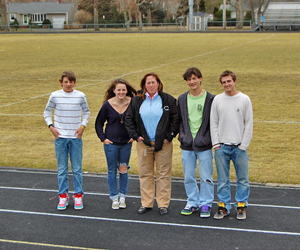
Lacrosse, soccer and football players inadvertently rip up the grass field, causing ruts that can send balls bouncing in unnatural directions, said Cory Hubbard, a senior who plays lacrosse and football on the main field. When it rains, Devin Mandell, a junior who plays lacrosse, soccer and track and field, said mud patches form and grit often finds its way into the eyes of players. And if the district resurfaced its running track, athletes wouldn’t get shin splints as often, said Alex Choi, a 17-year-old senior.
Perhaps most important to student athletes, a turf field will allow them to feel as if they were part of a serious athletic program. That’s hard to get past right now because, as Devin pointed out, something as seemingly harmless as a light drizzle can potentially sideline practices and delay games.
If its installation is approved, a turf field will enable the district to keep holding as many as 70 games a year on the main field. Holding that many games on a grass field is placing too heavy a strain on it, according to school officials. Ideally, only 20 games would be held on the grass each year.
Additionally, a turf field will enhance the district’s physical education program, said School Board President Aram Terchunian. He said the change will allow physical education teachers to extend their outdoor athletic sessions by five or six weeks each spring.
“We need synthetic turf,” Mr. Terchunian said. “Natural grass doesn’t do that.”
If the measure makes the ballot, and if taxpayers approve it, the turf field will be installed and track resurfaced by September, meaning that the football team will be able to finish its season on its home turf. The board approved that timeline at its last meeting on March 8. BBS Architect and Engineers of Patchogue, the firm hired to oversee the project, must complete preliminary work now so a building permit can be secured from the New York State Education Department immediately after the May vote.
The board could have delayed the preliminary work until after the referendum vote, but waiting would have pushed back the project’s start date until November, and it would not be finished before next spring. That timeline would have been much more dependant on the weather, as a few bad storms could have jeopardized the spring track season, which starts in early March, Ms. Masterson said.
The proposed joint project is not a new one. The Westhampton Beach Athletic Department began observing wear and tear on both years ago, and started pushing then for the work, Ms. Masterson said. About a year ago, the district’s facilities committee recommended that board members approve the project but they decided to hold off, citing financial concerns.
School officials said that they have found a way to pay for the projects without raising taxes. Board members have proposed transferring the $1.6 million needed for the work from the district’s bloated Employee Benefits Accrued Liability Fund, which covers compensated absences when employees retire, to a newly created capital reserve fund. The liability fund now contains about $4.5 million, according to school officials.
The turf installation is expected to cost about $1 million and the track resurfacing another $250,000, according to a report. If there is money remaining once architectural fees are covered, those funds will be used to construct about 70 parking spaces along Mill Road and next to athletic fields by the middle school.
But for the work to start, taxpayers must first approve the money transfer on May 18, according to Mr. Schwartz. He also explained that the state prevents the excess money from the district’s benefits fund from being transferred to its general fund. The surplus money also cannot be refunded to taxpayers, according to Mr. Schwartz.
“Since [the money] already exists, there would be no need to raise money through taxes,” he said. “Hence, no tax impact.”
Albany officials have asked school districts to reduce those benefits accounts, or state aid might be withheld, according to Mr. Terchunian. The Westhampton Beach School District receives about $3 million in state aid a year.
“Either we use it, or we can potentially lose it,” he said. “We think that now is the time to act.”
Still, Ms. Trager thinks the district would be better off spending those funds on real grass, as she and others, who she declined to name, remain skeptical of the true costs of installing and maintaining artificial turf. She is urging officials to replace the grass on the main field and utilize the Hite fields near the elementary school on Mill Road.
Ms. Trager also pointed out that more games played on the main field will mean that taxpayers will be paying for more school security. She noted that the district’s electrical bill will probably increase as the lights that surround the field will most likely stay on for more nights each year.
Though she supports resurfacing the track, Ms. Trager said the artificial turf is an expensive luxury item, adding that she wants the money was spent to support academic programs.
“Do they think they have a blank checkbook from the taxpayers?” Ms. Trager said of the School Board. “They can meet the needs of the community with a natural grass field.”
Bill Dalton, a Westhampton resident who supports the turf project, noted that some might oppose the referendum because of the costs associated with artificial turf.
“There are hidden things that people don’t realize,” he said. “It’s not free. It’s certainly not free.”
Even with those issues, Mr. Dalton said the entire community would benefit from the project, noting that taxpayers will be able to access the track and field. “I believe that, in the long run, it will be beneficial for the community,” he said.
Mr. Terchunian, meanwhile, said the costs of maintaining artificial turf are marginal. “We’re not talking about a lot of money,” he said, also referring to extra security and future electric bills.
Maintaining a turf field, which includes “sweeping” the field every four to six weeks, costs a maximin of $5,000 a year, according to Darren Gill, the marketing director for FieldTurf, a Peachtree, Georgia company that manufactures artificial fields. Most turf fields last between 10 and 12 years, and replacing them entails changing their “carpets,” or the surface containing 2.5-inch-long synthetic blades that are surrounded by rubber and sand. The subbase, or the crushed stone beneath the carpet that allows water to drain, should be replaced every 30 to 40 years, Mr. Gill added.
Michael Koziarz, a 1985 graduate of Westhampton Beach High School and a member of the district’s facilities committee, said that, in the long run, the district should save money in maintenance costs if it installs turf. He explained that he changed his mind after reviewing the facts and crunching some numbers.
“Why wouldn’t we do this?” Mr. Koziarz said. “Why would we short-change the children?”
The East Hampton and Southampton school districts both have turf fields, and the athletic directors from those districts said their athletic and physical education programs have benefited from the change. They said that turf is more durable than grass, allowing back-to-back games. And games can still be played on turf fields even when there are heavy rains, said Joe Vasile-Cozzo, the athletic director at East Hampton.
“You go on the grass, you get all wet and muddy,” he said. “You don’t have that with turf. It’s great.”
East Hampton’s turf field was installed about three years ago and funded through a bond that included other building projects still underway there, Mr. Vasile-Cozzo said. Southampton installed its turf field around the same time, in 2007, according to Darren Phillips, the athletic director at Southampton. His field cost taxpayers about $1 million and it was also paid for through a bond, which included an additional $5.5 million for other athletic department improvements, he said.
“We felt like, for the money, with all the use we’ll get out of it, it was worth the investment,” Mr. Phillips said. He added that his biggest challenge is making a schedule for all the teams and community organizations that want access to the field.
A turf field will also benefit the physical education program in Westhampton Beach, Ms. Masterson said. “It’s an extension of the gymnasium,” she said. “That [turf] field would be used from 7 a.m. to 7 p.m.”
Some parents, including those whose children play on Police Athletic League teams, are pushing for turf. Noel Laube of Westhampton Beach, whose two sons play lacrosse and football, said that PAL teams are currently not permitted to play their games on the main athletic field, relegating them to play on nearby substandard fields that are used for practice.
“We play what we call a home game, and we can’t even use a varsity field,” she said. “We’re stuck on this makeshift field that the varsity rips up from practices. It’s embarrassing.”
Ms. Laube said she’s also worried that some students will leave the district if they want to play sports, noting that, two seasons ago, she enrolled her sons in Eastport South Manor’s PAL leagues. The high school in that district boasts an artificial field.
“It’s turf,” she said. “It can be used unlimited amount of times.”
If the Westhampton Beach referendum is rejected in May, School Board members said they will continue “business as usual,” meaning that the grass field would be fixed and maintained. Eventually, Mr. Terchunian said the grass might have to be ripped up and replaced, at a cost of about $600,000. It would also mean that the district’s main athletic field would be out of commission for more than a year, forcing varsity and junior varsity teams to play on practice fields.
“Holy mackerel, that will just have huge impacts,” Mr. Terchunian said.
Mr. Schwartz said he does not know if the board would put the measure on the ballot again if it fails in May. But he did stress that both the athletic field and track would remain in a state of disrepair.
“The problem would still exist,” he said.


 Frank S. Costanza on Mar 17, 2010