


 8 Photos
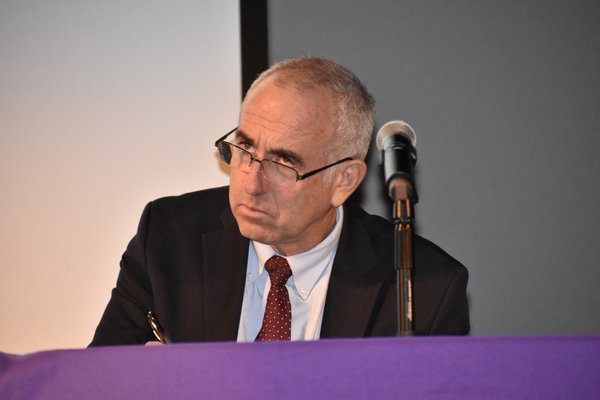
Southampton Town Supervisor Jay Schneiderman. VALERIE GORDON
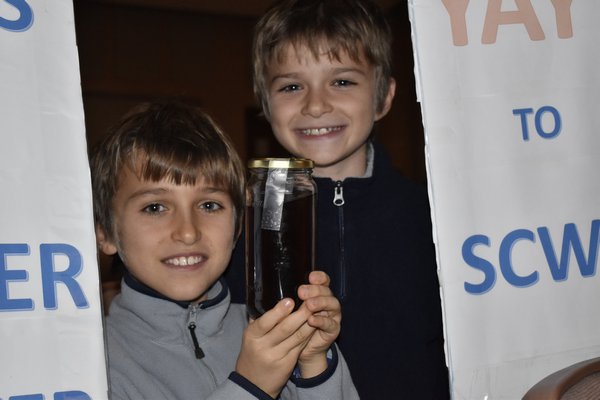
Anthony DePalma's sons

Kai and Ry
hold up a sample of dirty water from their faucet. VALERIE GORDON

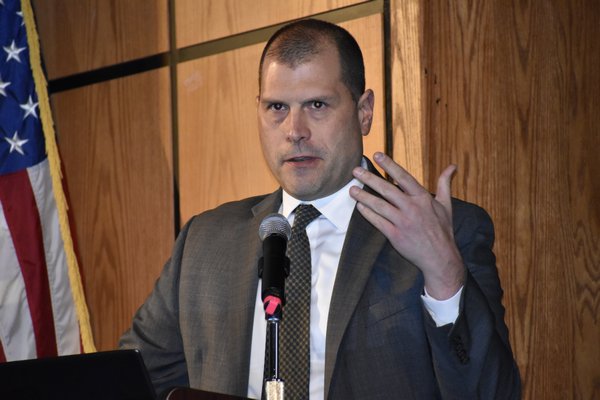
Southampton Town Councilman John Bouvier. VALERIE GORDON
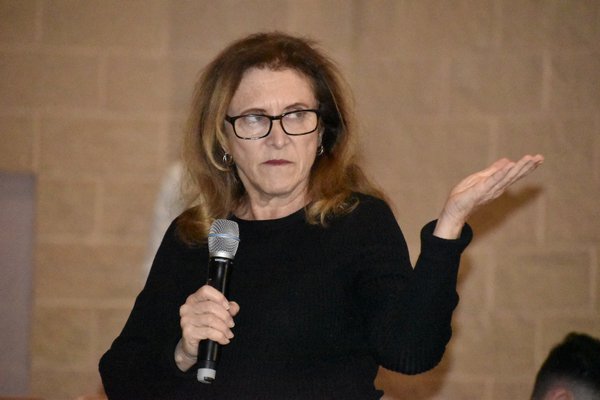
SCWA CEO Jeff Szabo. ALERIE GORDON
Vocal proponent Anthony DePalma. VALERIE GORDON

Shelley Borkoski called the SCWA proposal a "win win" for the residents of Hampton Bays. VALERIE GORDON
Tensions ran high at the first public meeting held by the Southampton Town Board to discuss a potential operational agreement with the Suffolk County Water Authority to take over the day-to-day management of the Hampton Bays Water District.
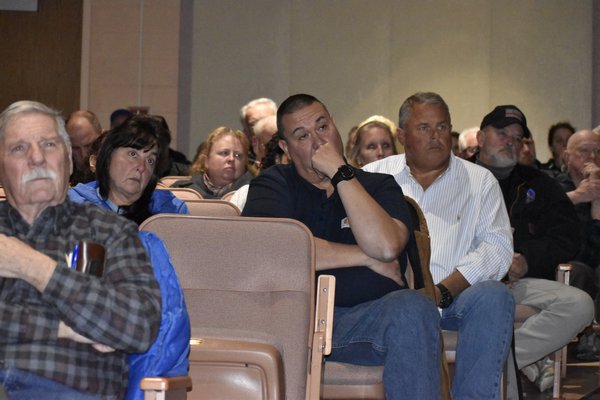
The majority of those in attendance strongly opposed the merger, noting that they were not willing to surrender local control of the water district to the regional water authority.
However, those sentiments contradicted the results of a recent survey, available on the Southampton Town website. According to Southampton Town Supervisor Jay Schneiderman, the town has analyzed the 300 responses received to date, and approximately 39 percent were in favor of the merger, whereas only 22 percent “strongly opposed” it.
“That’s almost twice as many feeling this is the right thing to do,” he said.
Still, those results reflect only that of 300 people within the hamlet. Currently, the water district serves approximately 6,400 customers.
At the meeting, held in the Hampton Bays High School’s auditorium on Wednesday night, November 28, many residents argued that the survey results could easily be tainted, noting that there was nothing to prevent someone from filling out the online survey multiple times.
The SCWA engaged in talks with Southampton Town officials back in August, roughly a year after the HBWD’s employees were “rocked” by an onslaught of water pressure and contamination issues, leaving the community unsure of whom to trust for providing clean water to their homes, according to Mr. Schneiderman.
“People keep telling me they're paying their water bill, but that they’re buying bottled water,” he said. “I want people to know that they can walk up to their faucet and have no fear. People have to know that their water is safe to drink.”
The proposed 40-year contract, delivered to the town in October, would allow the SCWA to manage the Hampton Bays water system for a quarterly fee. Mr. Schneiderman has repeatedly said the arrangement would mean a comparable cost to the annual $132 fee that water district customers are currently charged on their tax bill, which goes toward funding maintenance and debt service. The exact cost has not been disclosed.
Under the agreement, the Southampton Town Board, which acts as commissioners for the water district, would continue to set the rate at which residents are charged for water. Currently, per quarter, a water district customer using 3,500 cubic feet, or 26,182 gallons, pays a total of $44.80, including usage fees and other charges, whereas the same amount used by an SCWA customer would cost $46.72.
A key part of the proposal: It includes $6.1 million in infrastructure upgrades to be completed over the next three years if the plan is accepted.
Those upgrades include installing a $2.5 million manganese and iron filtration system, sandblasting and repainting the district’s water tanks to prevent them from rusting through, and installing booster systems to ensure adequate pressure, as well as backup generators and electric meters. Some of that work would need to be tackled by the HBWD if the merger falls through.
“Hampton Bays needs an iron and manganese filtration system yesterday,” Jeff Szabo, the authority’s CEO, said last week. “We’re prepared to make sure that capital work gets done.”
One of the benefits of entering into an agreement with SCWA, according to Mr. Szabo, would be that the costs for those improvements would be shared among the water authority’s 1.2 million customers throughout Suffolk County—rather than just the hamlet’s 6,400 HBWD customers.
Based on a previous interview with Mr. Szabo, it would take the water authority approximately a year and a half to add the new equipment.
Under the agreement, the local water district would maintain ownership of the district’s infrastructure.
Mr. Schneiderman stressed that regardless of whether the district was managed by the water authority, the upgrades must be completed.
He said, based on calculations completed earlier this week by Southampton Town Comptroller Leonard Marchese, that the average homeowner’s tax bill would increase by roughly $80 per year to cover the costs of upgrading the district’s current infrastructure if the merger isn’t completed and the work is tackled by the water district on its own.
Matthew Hattorff, president of the Civil Service Employees Association, Suffolk Local 852, argued against the merger, saying that the upgrade costs could be borne by local residents. “If you need to put money into it, you put money into it,” he said.
And while the majority of those who attended the public meeting were opposed to the merger, there were a select few in the audience who spoke of the agreement favorably.
Shelley Borkoski, a hamlet resident who took it upon herself to form a community group called “Hampton Bays Clean Water,” called it a “win-win.”
“We need to help our children—we have to help ourselves,” she said. “Think wisely—this sounds like a great deal for all of us.”
Another vocal proponent, Anthony DePalma, and his two sons, Kai and Ry, were met with angry shouts from the audience when they spoke in favor, with Mr. DePalma noting that “our infrastructure has been neglected. … We have some costly catching up to do.”
In addition to infrastructure upgrades, the water authority said it would offer additional benefits to the hamlet’s residents. Pointing to the recent discovery of two chemicals found in three of the district’s 11 drinking water wells last year—forcing HBWD Superintendent Robert King to shut off those contaminated wells for a little over a year to install a $1 million carbon filtration system at its headquarters off Ponquogue Avenue—Mr. Szabo boasted about the water authority’s in-house laboratory, saying the authority’s 40 chemists can turn around water testing results in a matter of days. Currently, the local water district uses an outside company to test water samples, and, according to Mr. Schneiderman, results can take as long as weeks or even months to get back.
Mr. Szabo added that the in-house laboratory technicians also test for 387 compounds—or 250 more than required by the state—including perfluorooctanesulfonic acid, or PFOS, and perfluorooctanoic acid, or PFOA, which tainted the hamlet’s water supply last year.
He added that in 2017, the water district tested for only131 compounds. In fact, according to a recent study by D&B Engineers and Architects of Woodbury, district officials failed to test several of the district’s wells for PFOA and PFOS in the first quarter of 2017—despite requests from the Suffolk County Health Department that it do so.
“We can guarantee that your water quality would improve,” Mr. Szabo said, noting that the authority has entered into similar agreements with water districts in Riverside, East Farmingdale, Brentwood, and Dering Harbor. “Throughout the course of our history, as municipalities like the Town of Southampton have approached us, we have entered into these agreements. Not one of them has come back and said, ‘This isn’t working out.’ All of those agreements are still in effect.”
The Hampton Bays district’s 13 full-time employees would be absorbed by the water authority and would be placed in positions based on their seniority within the water district. Tim Hopkins, general counsel for the water authority, said that each absorbed employee would be assigned to the authority’s Westhampton Beach location on Old Riverhead Road.
“They wouldn’t ever have to move if they choose not to,” he said, adding that, depending on the position, current district employees could see a $10,000 to $15,000 increase in their yearly salaries. “I think they would do much better if they were to accept employment with the SCWA.”
Mr. Schneiderman said that he extended an offer to Mr. King to make a presentation at the public meeting, arguing the case against the water authority’s involvement, but he said Mr. King was not prepared to do so.
Community members opposed to the merger, such as Bill Hughes, accused the Town Board, particularly Mr. Schneiderman, of pushing the proposal forward. “I think this is inherently biased and directed to the SCWA,” Mr. Hughes said.
To address those concerns the supervisor said: “We’re here for one reason, and that’s to provide the best quality of water. That's our only motive. That’s it. We just want to give you the best water we possibly can. Period.”


 Valerie Gordon on Nov 29, 2018