


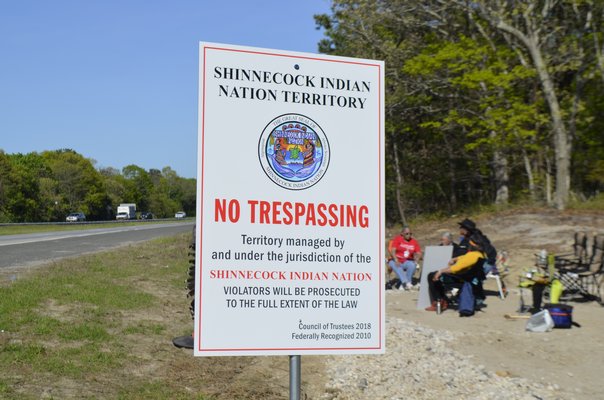
 2 Photos
Official Shinnecock Indian Nation signs say "territory." ANISAH ABDULLAH
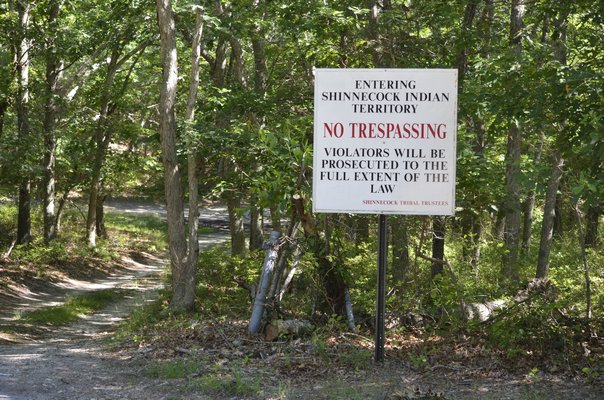
Official Shinnecock Indian Nation signs say "territory." ANISAH ABDULLAH
The Shinnecock Indian Nation’s 800-acre peninsula of land, known as Shinnecock Neck, has been called both a territory and a reservation — state law, Wikipedia pages and Google Maps list it as a reservation, but official tribal signage calls it a territory.
So which one is technically correct, and what is the distinction between them? Tribal officials Tela Troge, the tribe’s attorney, and Bryan Polite, chairman of the Council of Trustees, cleared up the ambiguity.
The officials said that their land is considered a territory and not a reservation, as the latter would be inaccurate. Ms. Troge defined a reservation as “land reserved by the United States for an Indian tribe,” which, in most cases, meant relocating tribes from their original land, but also meant land designation.
The federal government never had to reserve a site for the tribe because members have been living on their original land since around 1640.
“We’ve never been removed from our original territory like a lot of other tribes were, so that’s where the difference really comes in,” Ms. Troge said. “We weren’t placed onto a reservation, we weren’t relocated onto a reservation and we don’t have federal land. So that’s why you hear our land referred to as a territory.”
Referring to the land as “territory” became more frequently used among members after the tribe earned federal recognition in 2010, the two officials pointed out. The decades-long effort to gain such recognition required a “deep dive” into the tribe’s history, Mr. Polite said, in turn educating the community about the correct land designation.
“I would say that it was because of federal recognition that made people more interested,” the chairman said. “Because we were spending a significant amount of money on genealogists and people going through our entire history, people started to understand the distinction between sovereign territory and a reservation.”
Mr. Polite said that the Nation officially changed its letterhead in 2013 from “reservation” to “territory.”
Before being federally recognized, members generally called their land a reservation, which is how it is referred to in New York State Indian Law. Shinnecock land is considered one of the state’s 11 Indian reservations under the law.
“If you do hear Shinnecock land being referred to as reservation, it’s in reference to a state reservation status, not federal reservation status,” Ms. Troge said, adding that tribal members have taken pride in calling their land a territory rather than a reservation because of the higher level of sovereignty associated with the distinction.
Regardless of the correct term, many members will stay in the habit of calling their land “the rez,” Mr. Polite said.
“That has little to do with the distinction of the actual classification of the land and more to do with just, like, a local name for an area,” he explained.


 Anisah Abdullah on Sep 9, 2019