


 1 Photo
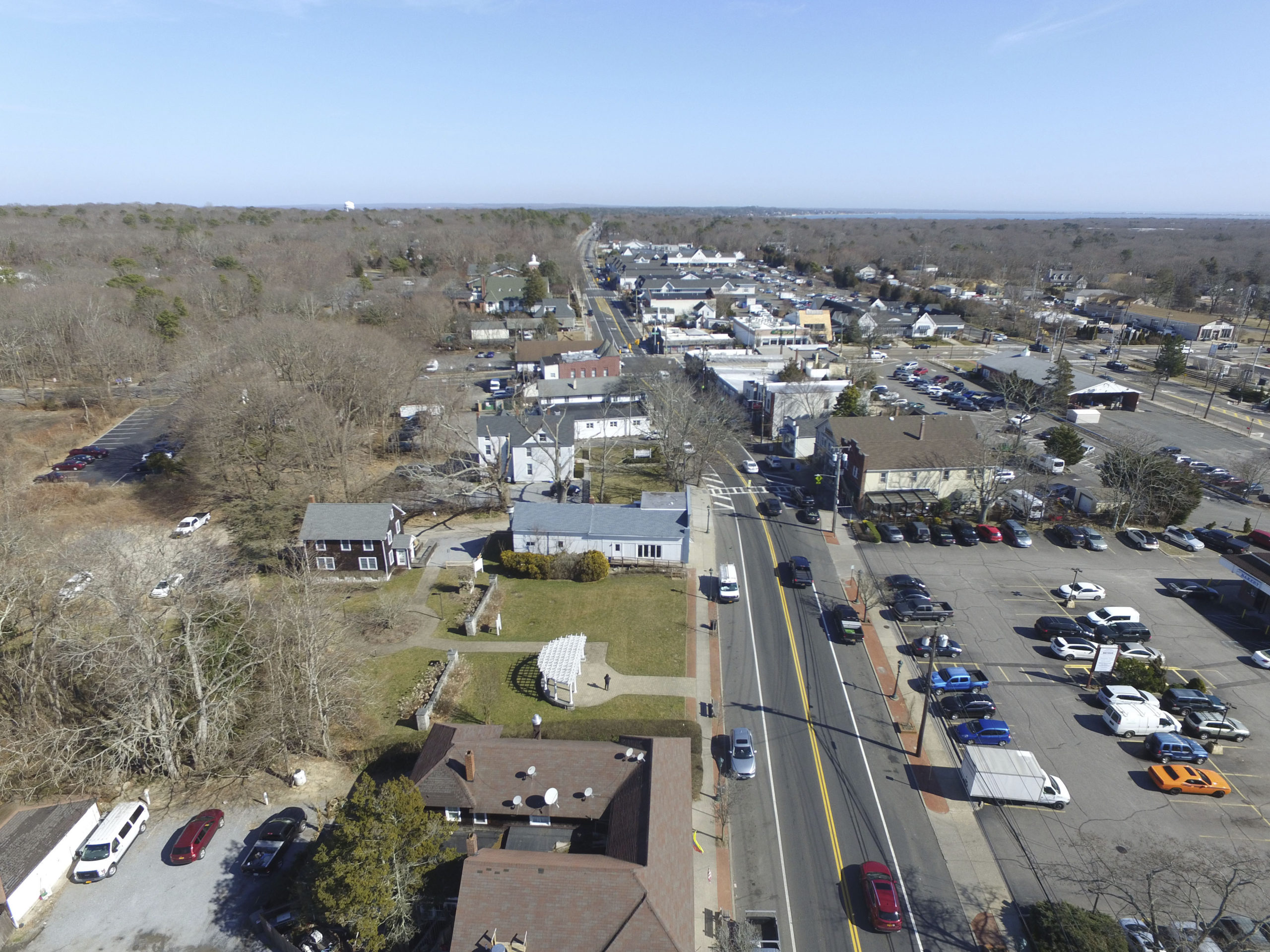
The Hampton Bays business district. DANA SHAW
Southampton Town Councilwoman Julie Lofstad said she’s confident that the Hampton Bays Downtown Overlay District — which was approved by the Town Board on Tuesday night — will ultimately benefit the people of Hampton Bays.
A resident of the hamlet, she supported the plan’s passage on Tuesday, bringing years of public hearings, charrettes and community meetings on the topic to a close.
The Town Board voted to approve the creation of the district and amend its zoning code to include a new chapter detailing the specifics of the overlay.
“Hampton Bays is a gem surrounded by an abundance of beautiful natural resources. Residents and visitors alike enjoy this bounty,” Ms. Lofstad said. “But, like with everything, balance is necessary. After a day at the beach, hiking, working or whatever, people look forward to going out to eat. They want to sit in a nice restaurant, or get a slice of pizza, then stroll around with an ice cream cone and maybe do a little shopping. Perhaps they will go to an event at Good Ground Park.
“Every downtown area can use a boost,” she added. “This plan will help our established businesses, and will encourage new businesses in the Hampton Bays downtown area by attracting more people to the area. This is the balance Hampton Bays needs to make the most of what we have now, and what we envision for the future. It uses of all our strengths, and adds to them.”
Four members of the board voted to adopt the new zoning code chapter. Councilman Rick Martel, a Hampton Bays resident, abstained from the vote. He owns Skidmore’s Sports & Styles on Montauk Highway, and said his business is located within the overlay. It's near on the boundary of the designated district, meaning outside the area he called "the epicenter," that runs west from Squiretown Road along Main Street. Mr. Martel decided to recuse himself from voting on the measure, because, he said, “I just didn’t feel it was right.”
Still, he added, “I’m in favor of it … We need to revitalize downtown. I hope it adds to an already terrific town.”
At the meeting that night, Supervisor Jay Schneiderman said he was proud of the work that went into crafting the code.
“It was four years of hard work,” he said, crediting the vision of Janice Scherer, the town planning and development administrator for the town’s Land Management Department. She saw the vision of what the community wanted, the supervisor said.
“We all see it, we all know it. It just has to happen.” Ms. Scherer said.
Not everyone embraced the measure, however. Members of the Hampton Bays Citizens Advisory Committee, in particular, have been critical of the plan.
“I support revitalization of Hampton Bays, but not urbanization,” the committee’s chairman, Ray D’Angelo, said in an email.
He pointed to nearby Riverhead and its school district, where “enrollment is increasing at an alarming pace,” and district voters on Tuesday rejected a nearly $100 million expansion bond. “The single-family homeowner becomes the victim of this urbanization push,” he said.
Another hamlet resident and CAC member, Thea Fry, also said she supports revitalization but had concerns about the new overlay district.
“This segmented approach is worrisome,” she said. “I believe we should be encouraging pop-up restaurants, stores, and craft breweries to entice young couples and families to our beautiful beaches and downtown. We need high-end stores to come to our hamlet — Lily Pulitzer, Ralph Lauren and Edward Archer — so our Main Street is packed after beachgoers return from a enjoyable day at the best beaches on the East End, and visitors can enjoy our Main Street, the best pizza and pork store ever, Peruvian foods that melt in your mouth. This is what our beautiful hamlet craves.”
“There was a comprehensive plan for the Montauk Highway corridor designed to spur economic activity in appropriate areas,” CAC member Mary Pazan said. “Segmenting out one piece of that plan not only misses the point of ‘comprehensive planning’ but raises questions regarding the board’s motivations. The board continuously focuses on building structures, ignoring other parts of the comprehensive plan that call for bike paths, tree-lined streets and acquisitions for pockets of open space.”
Local resident and CAC member Liz Hook, along with Ms. Pazan, is engaged in litigation with the town concerning the decision to purchase and redevelop the Bel-Aire Cove Motel. She weighed in on the vote in an email message.
“Once again, the board is moving forward with a developer-friendly plan in the face of opposition by the community,” the email read. “No doubt they will again dismiss the opposition as a small but vocal minority. But that does not change the fact that they have changed a plan that WAS supported by the community to one that, in a fundamental way, increases density, leading to even more traffic congestion and much less green space.
“Further, they have not satisfactorily answered how the current water supply shortage, which is causing low or no pressure problems for many residents, leading to the need to limit the use of sprinklers to alternate days, will not be further exacerbated by permitting up to 250 additional residential units in the downtown district. It’s time for the board to start being honest with the citizens of Hampton Bays.”
The new overlay district is a form-based zoning designation. Form-based codes differ from traditional zoning in that “they address the relationship between building facades and the public realm, the form and mass of buildings in relation to one another, and the scale and types of streets and blocks,” according to the website formbasedcodes.org.
A “pattern book” developed by the consulting firm Historical Concepts with input from community members “identifies the essential qualities and key patterns that should be encapsulated within an overlay district,” according to the measure’s environmental impact findings statement.
The targeted area is just under 55 acres and situated between Springville Road and Ponquogue Avenue, running north to Good Ground Park. In sum, the goal of the creation of the district, is the revitalization of the downtown district.
“The Town Board’s implementation of this optional zoning overlay will allow for the flexible, creative and innovative use of design standards to realize the forms of development and advance the town and community’s objectives to encourage the economic redevelopment of the Central Business District of Hampton Bays,” according to the findings statement.
Mr. Schneiderman has repeatedly pointed out that without the zoning code amendment, desirable development could not occur. Instead, he told members of the Hampton Bays Civic Association last fall, there could only be “more of the same … strip malls.”


