


 9 Photos
Rob Mellman
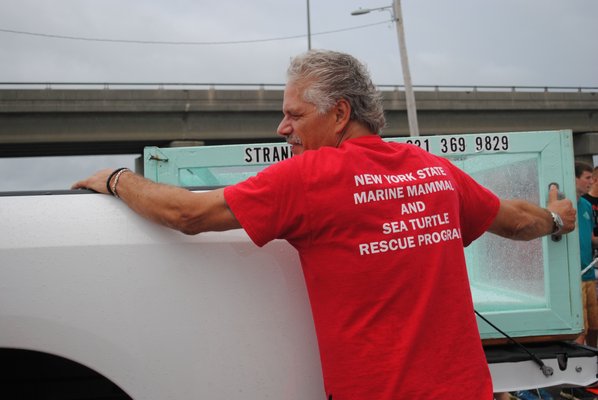
volunteer at the Riverhead Foundation for Marine Research and Preservation
takes a tank out of the truck at the sea turtle release. AMANDA BERNOCCO
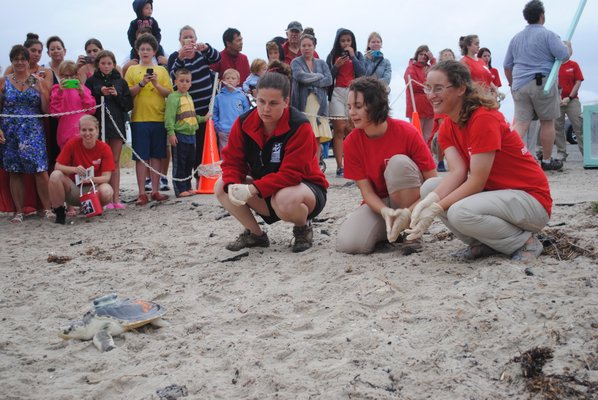
Three sea turtles were released into the bay under the Ponquogue Bridge in Hampton Bays. AMANDA BERNOCCO
Volunteers prepare to release Superman the sea turtle back into the water. AMANDA BERNOCCO
Superman the sea turtle walks slowly towards the bay. AMANDA BERNOCCO
Superman the sea turtle is ready to enter the bay for the first time since he was rescued. AMANDA BERNOCCO
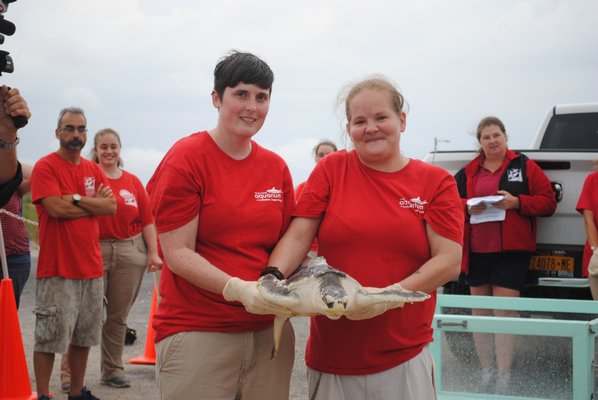
From left: Daniella Ferina
a staff member
Dr. Doom was having a rough go of it last fall.Unlike the Marvel Comics supervillain who shares the same name, the endangered Kemp’s ridley sea turtle was hardly a threat to others when he was found nearly unresponsive on an East Hampton beach this past November.
In fact, the cold-stunned saltwater reptile was near death.
“He had Class 3 cold stun, which is just below the worst level of cold stun,” said Robert DiGiovanni, executive director and a senior biologist with the Riverhead Foundation for Marine Research and Preservation, which spent the next eight months nursing Dr. Doom back to health.
There are four classes of cold stun, with the fourth being the worst, Mr. DiGiovanni explained. He noted that when rescuers found him, Dr. Doom was barely responsive, could not lift his head and had poor coordination.
Last Thursday, July 30, under the Ponquogue Bridge in Hampton Bays, Dr. Doom and two other previously cold-stunned sea turtles—Superman and Mr. Freeze, which were also rescued from East End beaches in November—were returned to their natural habitat by their rescuers.
Superman and Mr. Freeze, as well as all cold-stunned sea turtles rescued by the foundation this past winter, were named after either superheroes or supervillains by their rescuers. Superman and Mr. Freeze were found on beaches in Sag Harbor.
And all three can be thankful for the Good Samaritans who contacted the foundation after spotting the afflicted sea reptiles. “These three endangered turtles would have been left to die,” Mr. DiGiovanni said.
When ocean water suddenly drops in temperature and remains below 50 degrees, some sea turtles stop swimming and eating, making it impossible for them to escape to warmer locales. In these instances, the turtles are at the mercy of the currents and waves, with many of them washing ashore on local beaches in the late fall and early winter.
Those turtles that survive the ordeal, and are fortunate enough to be spotted by beach-goers, are typically recovered and rehabilitated by foundations officials. As part of that process, Dr. Doom and others are fed a regular diet of crabs and squid, according to Mr. DiGiovanni. They are released back to the water once they regain their strength.
Prior to being released last week, all three turtles had microchips installed under their skin and tags attached to one of their flippers. Both identify the turtles as originating from New York, according to Mr. DiGiovanni.
Additionally, Dr. Doom and Superman had satellite monitors attached to their shells that will allow researchers to monitor their whereabouts so they can study migration patterns. Mr. Freeze suffered severe frostbite on his shell and, due to its sensitivity, researchers opted not to outfit him with a similar tracker.
In 2014, foundation scientists responded to 30 reports of stunned sea turtles across Long Island, according to Valentina Sherlock, volunteer coordinator and research assistant with the Riverhead Foundation. She noted that nine of those turtles—including Dr. Doom, Mr. Freeze and Superman—survived.
“Releasing one really does make a difference,” said Kim Durham, rescue program director for the foundation, explaining that the hope is that they will eventually mate and reproduce.
Regarding the comic book-inspired names of this year’s rescues, Ms. Sherlock explained that each year, foundation volunteers select a theme. For example, in 2013, the theme was famous shipwrecks on Long Island, and, the year before that, Disney characters.


 Amanda Bernocco on Aug 3, 2015