


 4 Photos
Hampton Bays residents and Southampton Town officials are hopeful that a budding technology will help prevent stormwater runoff from contaminating local bays while also distinguishing the hamlet from others in the town.
The idea behind the structures—known as bioswales, or vegetated swales—is to funnel stormwater into roadside gardens consisting of plants that are proficient at filtering contaminants like salt, rubber, oil and various other automotive fluids that get flushed from the road’s surface by rainwater.
As the stormwater seeps into the ground, moving past the plants, their roots and the soil below, the contaminants are removed, leaving only clean water to enter the watershed, Marc Fasanella, a professor of ecological design at Stony Brook University, explained during an interview last week.
The bioswales would replace traditional storm drains that typically funnel the water into either an underground temporary holding chamber or a surface-level sump.
“You’re trying to slow the water down,” Dr. Fasanella said. “All traditional stormwater management is trying to move water as fast as possible off the road and into a storm drain.
“What we’ve realized now,” he continued, “is that is you want to slow it down so it can percolate through the soil. When it percolates through all those layers, microorganisms are eating the plastics and the inorganic compounds. They’re kept at the surface, and the water percolates down.”
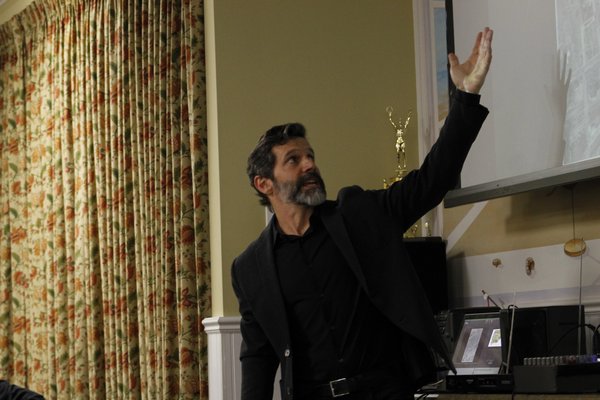
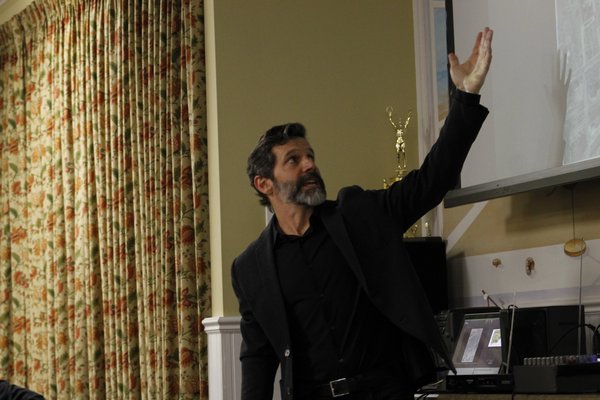
Bioswales were among a bevy of proposed features highlighted by Dr. Fasanella in a series of lectures presented to the Hampton Bays Civic Association, of which he is a member, over the past several months.
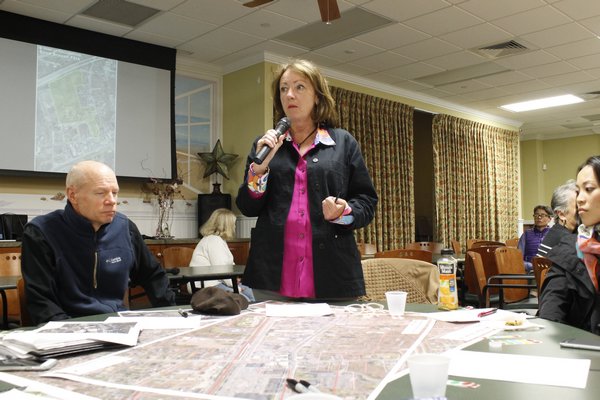
During a charette-style vote held by the association to determine what improvements residents would like to see made to Hampton Bays after hearing Dr. Fasanella’s most recent presentation, bioswales were a top priority for nearly everyone in attendance. The idea garnered at least twice as many votes as any other element discussed that evening, including lofty proposals such as the introduction of a trolley that would run from Main Street to the local marinas, and the construction of a community pool.
“The bioswales were really amazing and beautiful,” Denise McCaulley of Hampton Bays said after the gathering, held on May 21. “Waste in general is something we need to focus on if want to bring more people and businesses into town.”
In addition to the ecological benefits that Ms. McCaulley spoke of, other hamlet residents, like John Capone, supported them for their aesthetics as well. “People talk about wanting Hampton Bays to have its own character that sets it apart from other areas,” he said. “I think bioswales would be a great way to do that.”
Dr. Fasanella explained that while bioswales have grown in popularity in recent years, the principles behind them are nothing new. Xeriscape gardens, or those that survive solely on rainwater, have been a topic of study since the 1970s, he noted.
Southampton Town Deputy Supervisor Frank Zappone said bioswales are something the town is strongly considering in Hampton Bays, particularly for the Good Ground Park project that he is spearheading.
The proposed park, the design of which has been partially funded by state grant money, is slated to be built on 36 acres of land just north of the Main Street section of Montauk Highway in Hampton Bays by summer 2016. Mr. Zappone said there are several areas in the park where bioswales will likely be used to filter stormwater runoff.
“It’s decorative, it’s functional, it’s green, and there’s a cost savings in that the typical approach is to install stormwater drains, and this could remove that infrastructure, which costs money to maintain,” he said.
Mr. Zappone said the new street that would run through Good Ground Park—a roadway that is tentatively being referred to as a new North Main Street—would be an ideal place for roadside bioswales. He added that property owners could be encouraged to include bioswales in any proposed redevelopment that goes before the town’s regulatory boards.
Presently, much of the stormwater runoff from Main Street ends up in a sump that sits across the street from the Hampton Bays Firehouse on West Montauk Highway, Mr. Zappone said. That property, which is owned by the Hampton Bays Fire District, might be purchased by the town and added to the park, Mr. Zappone said, adding that the district is a willing seller, but the proper protocols must be followed before the transaction can take place.
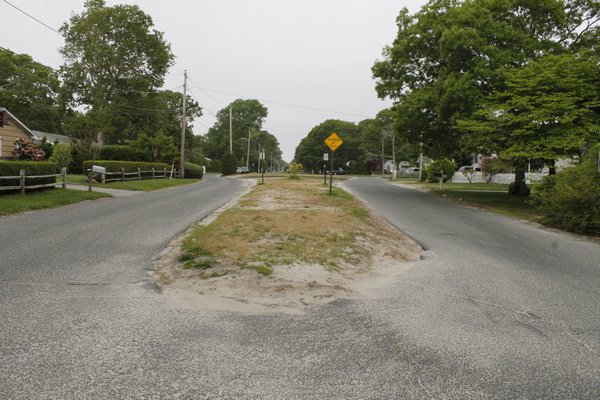
Dr. Fasanella suggested Maryland Boulevard as another location for a bioswale in Hampton Bays. Just south of the Hampton Bays High School campus, the road has a roughly quarter-mile stretch where the eastbound and westbound lanes are separated by a strip of grass, which could be converted into a bioswale by making the grassy area sloped into a trench, then planting deep-rooted trees, perennials and grasses that thrive in both wet and dry conditions. Dr. Fasanella noted that many native species, including beach grass found on local dunes and near saltwater marshes, would be ideal for such installations.
In addition to the street-side, or right-of-way, bioswales, the likes of which the New York City Department of Environmental Protection has been installing in Brooklyn, Queens and the Bronx since 2012, the water collection installations could also be placed within roadways and covered by storm grates, Dr. Fasanella said. He recommended the area near the Montauk Highway-Canoe Place Road intersection, and the painted medians near the Hampton Bays Diner, as areas where these “sunken gardens” could be installed.
“It’s not any more costly than putting in one of those other traffic islands or raised garden sheds,” Dr. Fasanella said. “You just need someone to be a steward of it, because people will drop garbage that will inevitably collect in it.”
In addition to the New York City effort to install right-of-way bioswales, third-party groups like GrowNYC and Bronx GreenUp also have installed them in community gardens. Some of these installations funnel the collected rainwater through additional filtration devices made of cloth or crushed stone before it flows into the ground.
GrowNYC spokesman Lenny Librizzi said while the plants in the bioswales need to be watered and tended to after they are initially planted, they eventually become self-sustaining. He added that other major cities, such as Seattle, Philadelphia and Minneapolis, also utilize bioswales. Dr. Fasanella said many smaller communities throughout the country also have set up successful installations.
New York City DEP spokesman Edward Timbers said the city-funded bioswale projects have been effective and well received by the public. “Community response has been positive,” he said. “The addition of trees and hardy plants beautifies neighborhoods and helps to clean the air.”


 Kyle Campbell on Jun 10, 2015