


 2 Photos
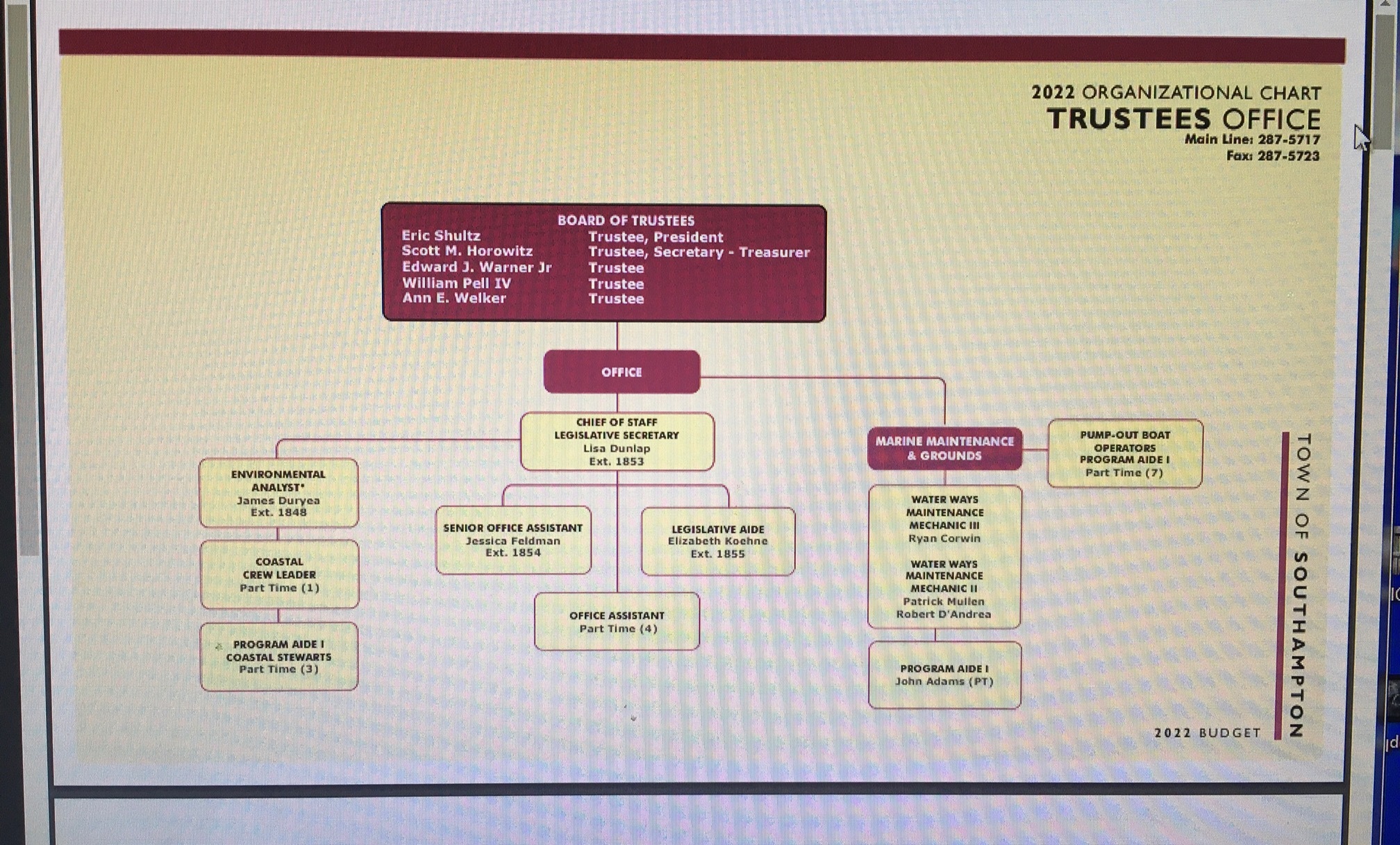
A chart in the town's 2022 adopted budget begins the section of the tome devoted to the Southampton Town Trustees. With last week's unanimous vote, the information will be easier for taxpayers to access.
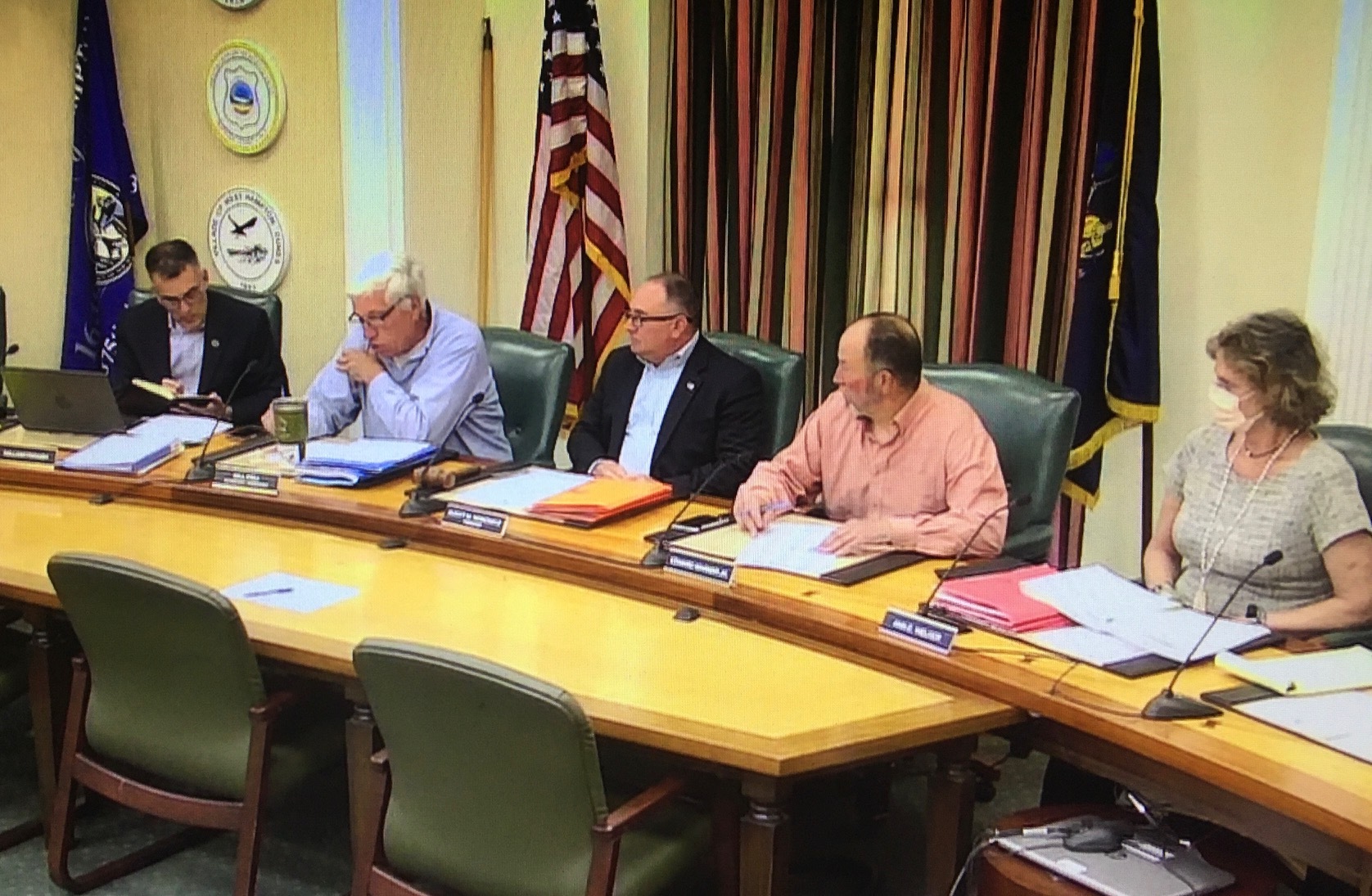
The Southampton Town Trustees, from left to right: William Parash, Bill Pell, Scott Horowitz, Ed Warner, Jr, and Ann Welker.
What is the true cost to taxpayers for operations, employees and initiatives attached to the Southampton Town Trustees?
Earlier this month, members of the Town Board unanimously ratified a measure that will readily provide that information as a separate line on a property owner’s tax bill — and give the Trustees the authority to set their own budget.
Prior to the creation of a separate tax line — similar to what a resident might find for their local fire district — Trustees’ expenses were mostly depicted in the town’s adopted budget, available online to view for anyone with the patience to dig in. “Mostly” because some costs were not shown; they were covered in the town’s general fund.
The adopted 2022 budget shows a total cost of the town’s oldest elected body at approximately $1.389 million. However, Southampton Town Supervisor Jay Schneiderman explained, other costs associated with the Trustees are not shown in that number.
There are direct and indirect costs, Town Comptroller Leonard Marchese explained. For example, the Trustees have office space, receive support from the town attorney’s office, Human Resources and Information Technology departments, and more.
“There’s a value in every service,” Trustee President Scott Horowitz said, “except you can’t see it, it’s not clearly transparent.”
The plan is to put together a list of indirect costs and direct costs and, taking them from the general fund, add them to the Trustees’ separate budget, Marchese clarified. The total amount of money collected in taxes won’t change; it will just be shown to the community differently.
Officials underscored that point. “It’s a budget-neutral exercise,” Horowitz asserted, “but it will clearly represent to the taxpayers how much of their tax money goes to the cost of the Trustees.”
Schneiderman worked with Horowitz to create what the supervisor described as a huge spreadsheet that shows costs “down to the copy machines.”
“Those other things add up to around $200,000,” Schneiderman said, this week estimating the total cost at $1.9 million, with some $1.3 million covered by property taxes and the balance with grants and fees. “Jay and I got the ball rolling,” Horowitz said. He anticipates there will be “other eyes on it,” as time goes by.
There’s another aspect to the move: With a separate tax line codified, future Town Boards can’t decide to defund the Trustees. The line provides the stewards of Southampton’s more than 25,000 acres of undivided, colonial-era lands consisting mostly of Southampton’s shores, water ways, marshes, and bottomlands with autonomy, and security.
Accompanied by Assemblyman Fred W. Thiele Jr., Horowitz met with the Town Board in March to discuss the issue. He noted then that past administrations have threatened to defund the Trustees, leaving them unable to perform the services they do for the community.
The Trustees constitute a separate and independent municipal body, but with their budget under the Town Board’s review and power to amend or even abolish, Schneiderman pointed out during the meeting. “They’re kind of at the mercy of the Town Board,” the supervisor said. “So if one year we decide to defund them in the budget, they’re out of existence. But that’s something none of us wants to see.”
To create the new tax line, the town needs state authorization. When it comes to implementation, the locals take the reins. “We give you the authority, and you figure it out,” Thiele said during the March work session. “The authorization is fairly straightforward.”
The Town Board on May 10 passed memorializing resolutions in support of Assembly and Senate bills that amend Article 107 of State Town Law to authorize “the establishment of a procedure relating to the adoption and submission of an annual budget by the Trustees of the Freeholders and Commonalty of the Town of Southampton,” the town resolution states.
The Trustees’ authority, the Dongan Patent, dates to colonial times. The tax line measure gives them authority over their own finances, except for as it pertains to two issues — borrowing money and the statewide tax cap. Any money borrowed relies on the town’s borrowing power. The full faith and credit is behind the bonds of a local government, and only one body at a time may do that, Thiele said. For any capital project that relates to the bonding of money, they’d still have to go to the Town Board.
Under State Town Law, the Trustees prepare their own budget, including the tax levy needed. It’s submitted to the Town Board and attached to the town budget. With the new legislation adopted, the Town Board would not have the power to change the Trustees’ budget. That’s the essence of the autonomy the Trustees would have, Thiele explained.
The Trustees could increase their levy within the tax cap, but if they needed to exceed the cap, they’d have to get permission from the Town Board. “As long as their budget request is within the approved state cap, it must be put on the tax bill,” the supervisor said.
The measure will provide stability, Horowitz said. “It’s going to mean we’re all working better together. This is a historic moment in time.”


