


 1 Photo
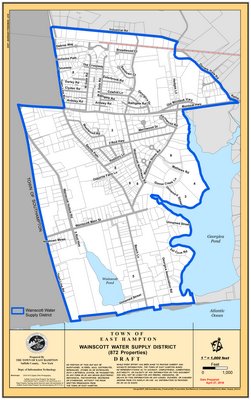
The town will extend water mains throughout the newly created Wainscott Water Supply District
The State Legislature has approved a pair of bills that could allow East Hampton Town to use some of its Community Preservation Fund revenues to pay for the extension of water mains in Wainscott, providing access to public water in response to groundwater contamination concerns.
Both houses of the legislature this week supported amendment legislation that State Assemblyman Fred W. Thiele Jr. and State Senator Kenneth P. LaValle said “clarifies” the 2016 extension of the CPF program and new allowance for up to 20 percent of a town’s CPF revenues to go toward water quality improvement projects. The amendments specify that the money may be spent for the construction of water mains and connections to homes whose drinking water supplies have been contaminated by toxic substances.
The bill must still be signed by Governor Andrew Cuomo for it to become law.
The sponsors say the new wording will avoid confusion about when installing water mains constitutes a water quality improvement project, which is eligible for CPF funds.
“We felt that it was necessary to make it more explicit that this kind of project is only okay under CPF when the project is to provide clean water to areas that are contaminated,” Mr. Thiele said on Monday. “I felt that the way the law was originally written, there could be abuse. But it would be hard to argue to people who have contaminated drinking water that you can’t use a water quality improvement fund to provide them with clean water.”
The bill, Mr. Thiele added, was spurred by the still-unfolding discovery that drinking water supplies in southern Wainscott have been contaminated with a pair of compounds, known as PFOS and PFOA, that have been found to be a potential health concern only in recent years. The chemicals were widely used for decades in the manufacturing of fire-suppressant foams used at airports and in a wide variety of waterproofing treatments for products from carpets to pizza boxes.
The State Department of Environmental Conservation is still investigating the source of the contamination in Wainscott, but conventional wisdom has pointed to the storage of firefighting foams at properties in the East Hampton Airport industrial park or their use in firefighter training exercises nearby.
In the wake of the discovery of the contamination more than a year ago, the town declared a state of emergency and has been providing bottled water to homes in the area. Later this summer the Suffolk County Water Authority will begin extending its water mains to all of the neighborhoods in Wainscott south of the airport—a project expected to cost about $24 million that will be paid for, at the outset, by the town.
Supervisor Peter Van Scoyoc said that applying CPF water quality funds to the Wainscott project had been discussed informally but thus far has not been seriously looked at as one of the funding choices the town plans to pursue.
As of now, the town has agreed to borrow the full cost of the installations. It will tax homeowners for the costs of their individual connections to the mains—which can vary widely from property to property depending on how far from the nearest roadway the house is. The town and Suffolk County Water Authority will apply for up to $10 million in grants from the state to put toward the remainder and would cover any leftover costs with the town general fund.
“We will take it up with our water quality technical advisory committee, which has to recommend projects to the Town Board,” Mr. Van Scoyoc said. “We have a limited amount of money we can spend on water quality projects in a given year and we’re going to have to prioritize those projects.”
The town has about $5.8 million available for water quality projects in 2018 and has assigned less than $1 million to water quality improvement projects thus far. The board has approved several stormwater runoff abatement projects around Three Mile Harbor and Lake Montauk and has received proposals from Sag Harbor Village for another, Mr. Van Scoyoc said.
The State Legislature this week also approved bills that would allow the East End towns to make loans from CPF revenues to homeowners to cover the costs of replacing aging septic systems. The legislation—which also must still be signed by the governor to become law—would allow the towns to help homeowners cover the costs of replacement up front, rather than the homeowner having to put up the money out of pocket and then seek rebates from the town.
The rebate amount would be deducted from the loan, and the remainder could be repaid into the town CPF with an assessment on annual tax bills over as many as 10 years.
When the CPF extension and water quality allowance were created in 2016—with broad voter support at the polls—Southampton and East Hampton towns said they expected a substantial portion of the annual funding to go to the replacement of individual septic systems at private homes, the main source of the nitrogen pollution that was billed as the main reason for needing the new water quality allowance in CPF.
Both towns set up rebate programs that would reimburse homeowners up to $16,000 for the costs of new nitrogen-reducing systems. In the first year of the programs, however, the septic replacement rebates have had a lukewarm reception from homeowners. East Hampton, which has some 12,000 homes with outdated septic systems, to date has received just 65 applications for rebate eligibility but has seen only five new systems installed and has awarded only three rebates for completed replacements.
“This would relieve homeowners from having to go out of pocket while they wait for the rebate,” Mr. Van Scoyoc said. “It’s still a new program, and we’re still working on informing the public that this is available, and I think this will be a big help in convincing property owners this is something they should do.”
Mr. Van Scoyoc said the town has also been discussing the possibility of increasing the size of the rebates offered, as some projects have proven to cost as much as $20,000 if relocating water wells or accessory structures is required in the installation of the new nitrogen-reducing systems.


 Michael Wright on Jul 31, 2018