


 5 Photos
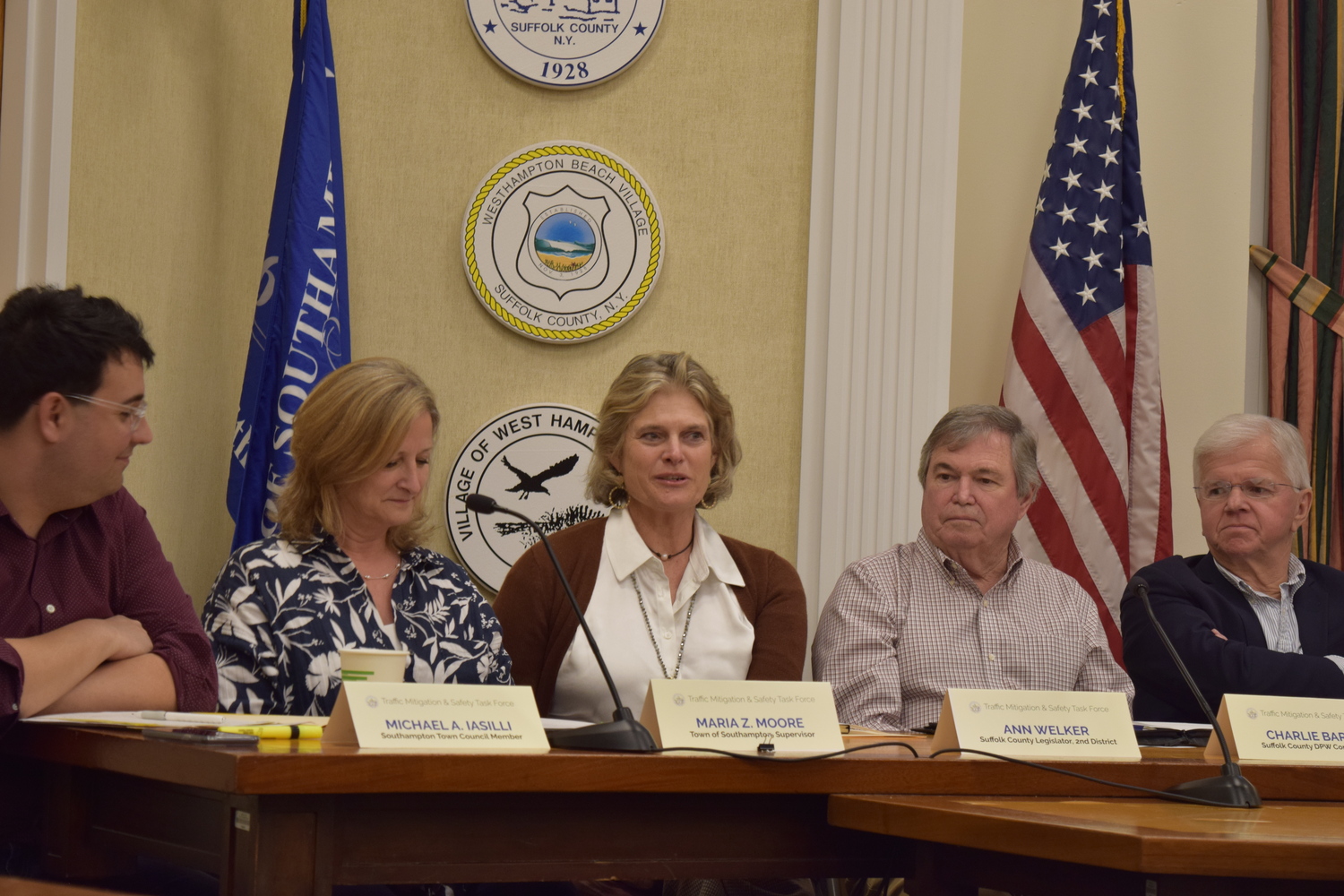
Suffolk County Legislator Ann Welker is a member of Southampton's Traffic Mitigation and Safety Task Force. CHRISTOPHER WALSH
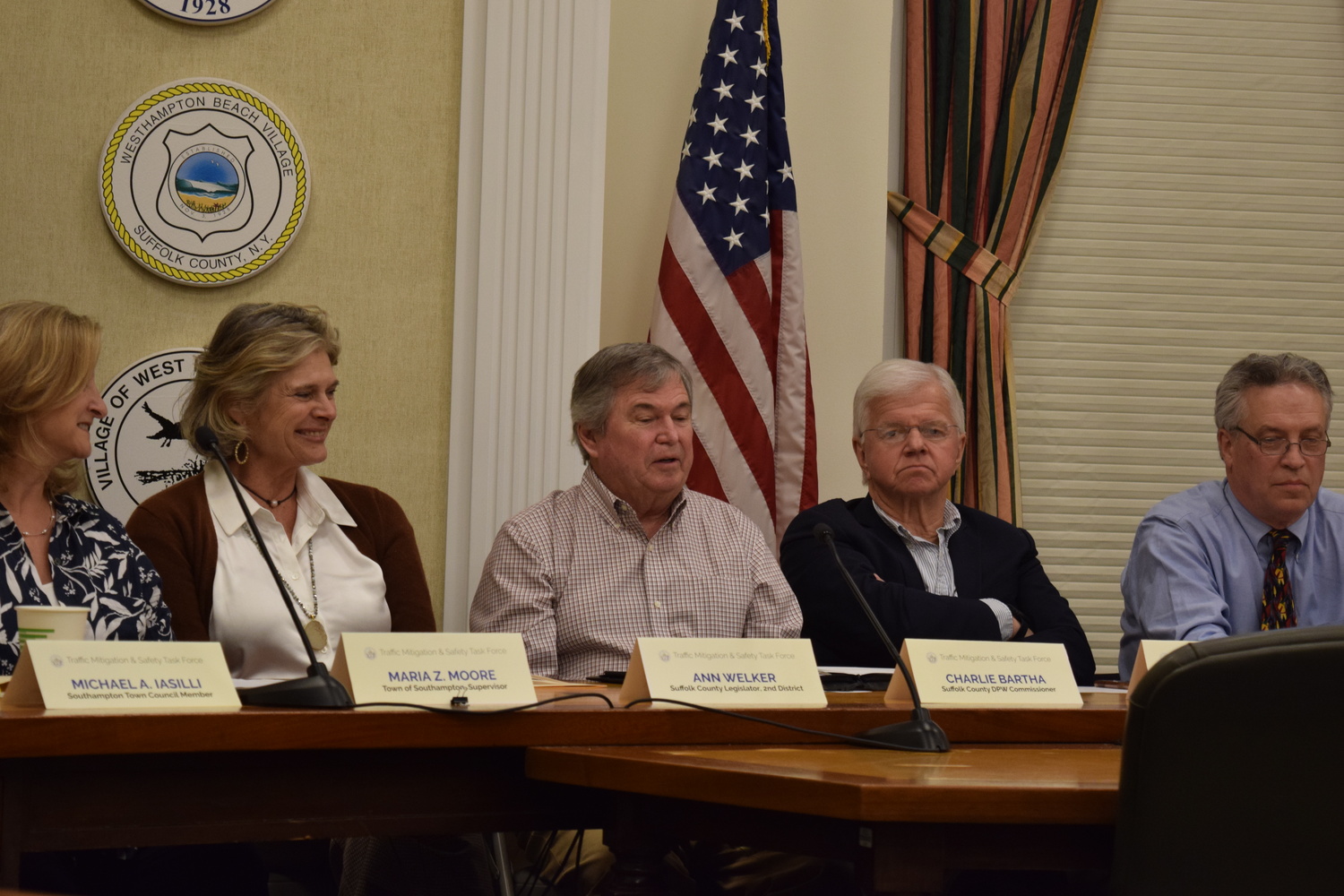
Charles Bartha of the Suffolk County Department of Public Works said that the county has selected a consultant to conduct a study of County Road 39. CHRISTOPHER WALSH
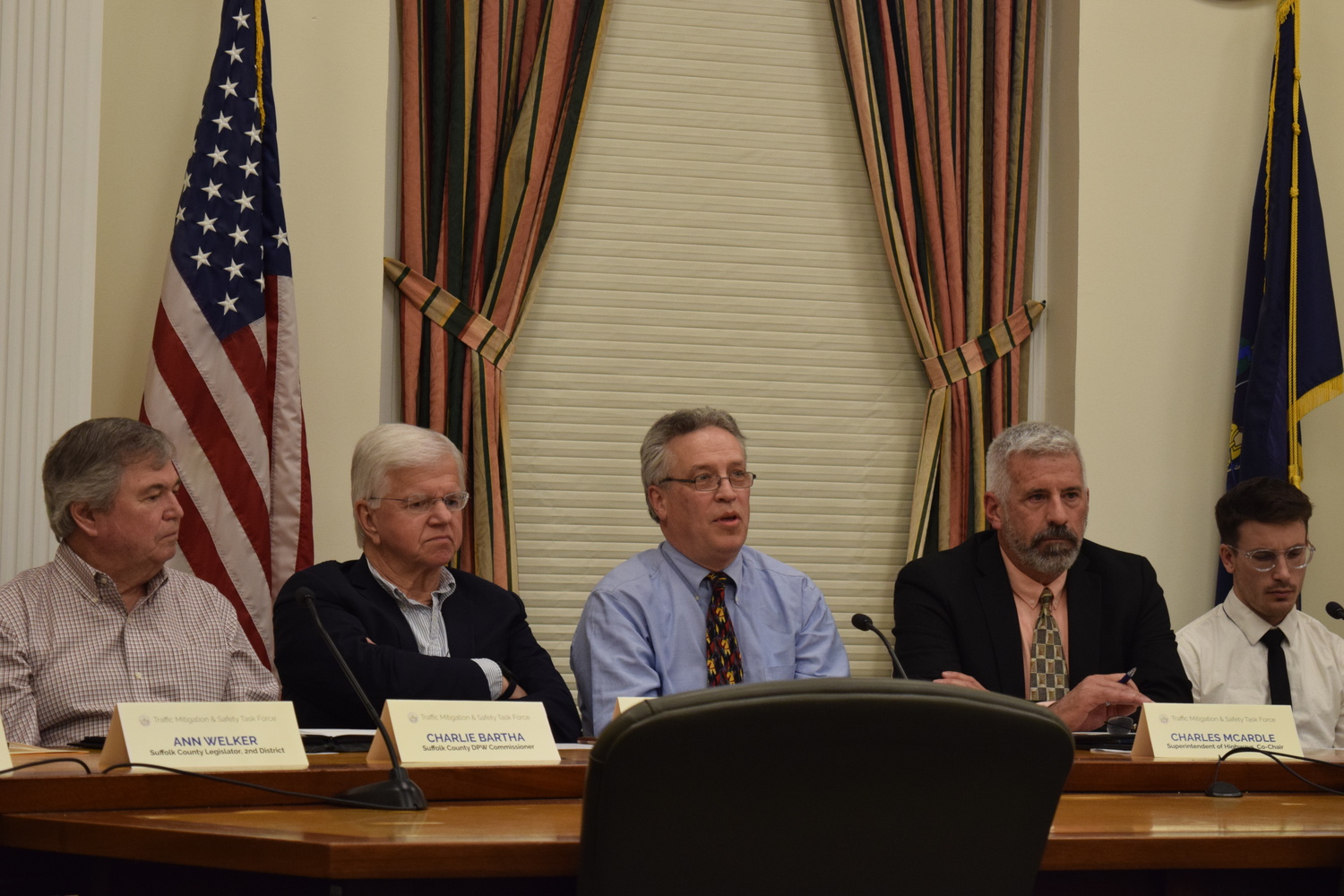
Former traffic safety director Tom Neely warned that expectations for traffic mitigation must be realistic. CHRISTOPHER WALSH
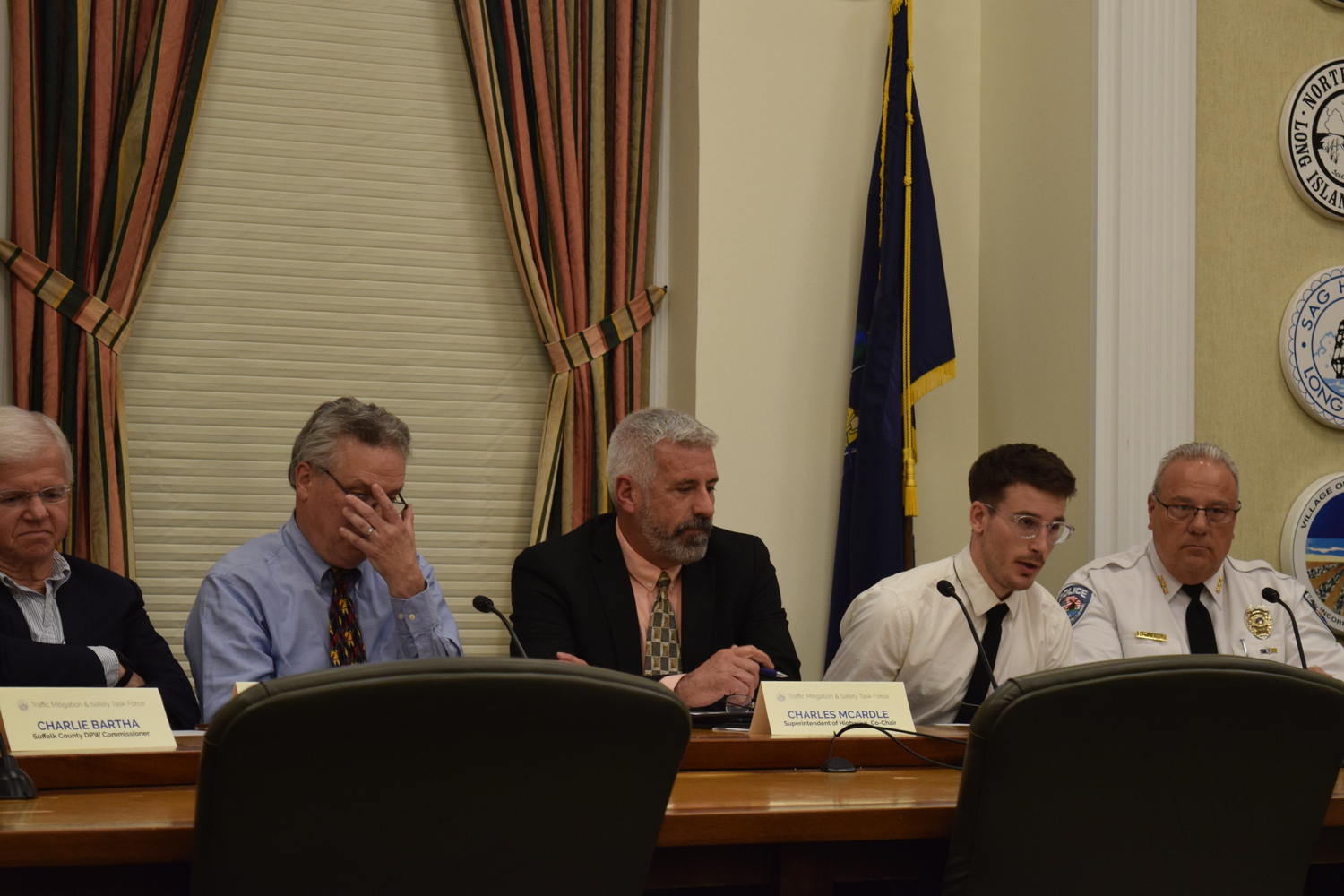
Charlie McArdle, the task force co-chairman, spoke of the importance of short and long-term solutions to traffic congestion. CHRISTOPHER WALSH
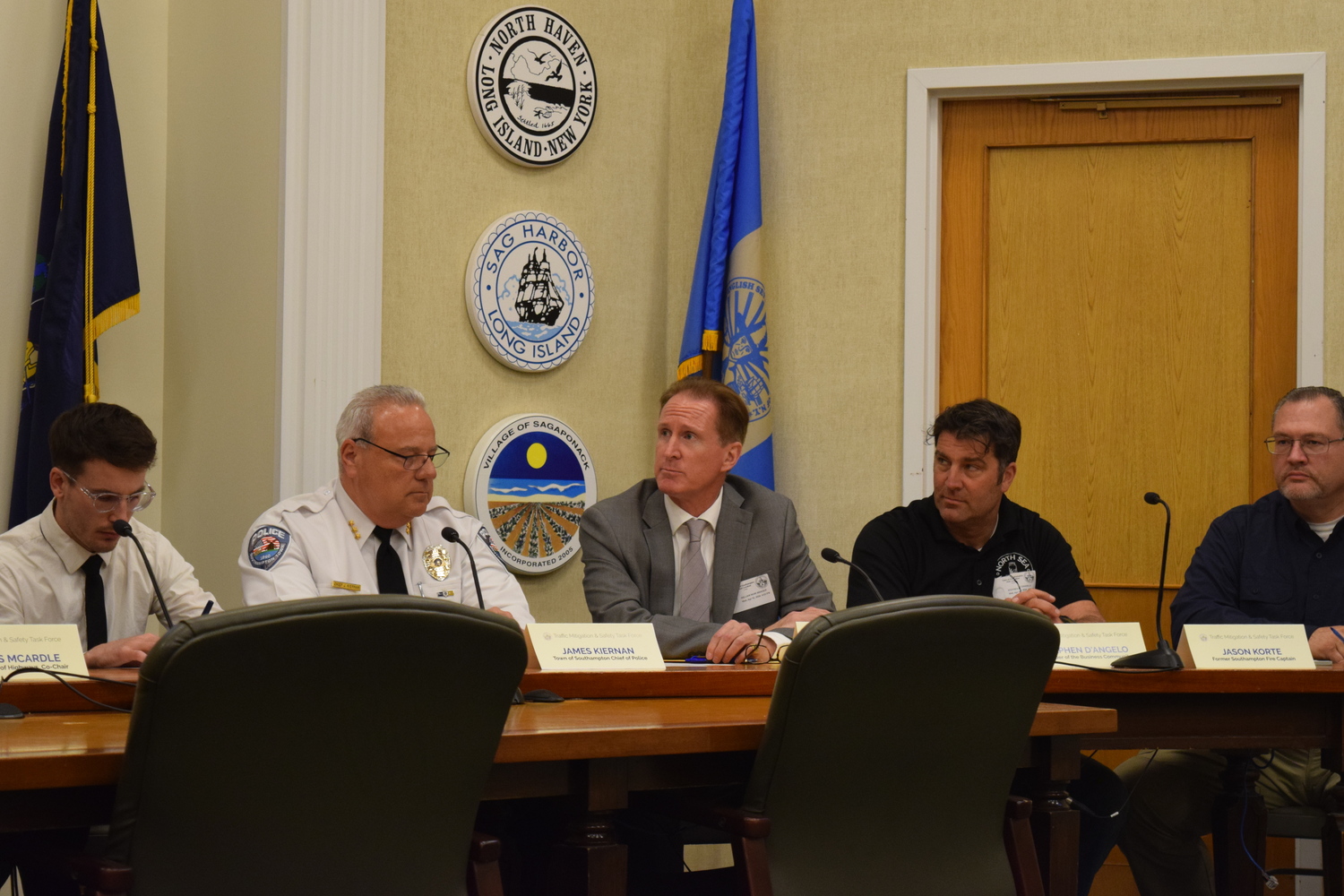
Mayor Bill Manger said that County Road 39 should be re-engineered. CHRISTOPHER WALSH
The Southampton Town Board’s Traffic Mitigation and Safety Task Force, created in February to address a chronic and worsening situation, held the first of six planned meetings on April 10 at Town Hall.
“This committee needs to focus on two things: the long-term solution, and can we institute short-term solutions so people aren’t so frustrated,” summarized Charlie McArdle, Southampton Town’s superintendent of highways.
Four years after the COVID-19 pandemic brought an influx of people to eastern Long Island, many of whom remain year-round residents, traffic across the South Fork is a vexing issue throughout the year.
In February, the Town Board voted to create the group tasked with identifying and studying heavily trafficked corridors, collecting information from the public and traffic professionals regarding solutions and mitigation, and creating and issuing a report with findings and recommendations to be presented to the Town Board.
In addition to McArdle and his co-chairman, Tom Neely, a former traffic safety director for the town who now serves as a consultant, task force members in attendance were Supervisor Maria Moore and Councilman Michael Iasilli; Suffolk County Legislator Ann Welker; Charles Bartha, commissioner of the Suffolk County Department of Public Works; Assemblyman Fred W. Thiele Jr.; Tom Houghton, the town engineer; Town Police Chief James Kiernan; Southampton Village Mayor Bill Manger; Steven D’Angelo, owner of North Sea Hardware; and Jason Korte, a former member of the Southampton Fire Department.
Also on the force but not at the meeting are Bianca Collins of the Shinnecock Nation Council of Trustees and Donna Kreymborg of Southampton Volunteer Ambulance.
The task force is working concurrently with a Suffolk-led study of County Road 39, the most oft-mentioned roadway at its initial meeting.
“We have to be realistic,” Neely said, “that as far as the roadways go, these have inherent design issues, if you will — that they’re not limited-access highways. These are roads with multiple driveways, multiple intersections.
“I think we’re going to be able to make some improvements, but I think our improvement in getting people around is going to be a combination of, hopefully, some infrastructure improvements, some elements of public transportation” — such as greater Long Island Rail Road service — and “looking at transportation management strategies to basically change a little bit of people’s travel habits,” the latter effort to be taken up at future meetings, he said.
Along with public transportation and land-use issues, housing falls under longer-term solutions, he said.
Participants offered several observations during the freewheeling discussion. As if to illustrate the scope of the problem, Houghton, who cycles to work from Flanders and said that it takes the same amount of time as commuting by car, noted, “I can’t even get traffic engineers to work for the Town of Southampton, because they won’t travel out here — it’s an hour from Riverhead.”
He proposed that Route 24 in Flanders, “which is gridlocked, for the most part, with the addition of traffic lights for the past five years,” be included in the task force’s deliberations.
“I’m hearing that traffic lights need to be synced up in a better way,” Iasilli said. “It’s throwing the balance of the traffic flow out of whack.”
“Everything that we’re talking about are on state and county roads, for the most part,” Houghton answered. “All those lights are state and county lights that the town maintains. We don’t control the timing — we don’t really control anything other than making sure they’re operational.”
If a motorist on Tuckahoe Road at the Montauk Highway intersection is waiting for the light to turn green, “you’re going to be pissed off, because you’re going to be waiting a long time,” McArdle said. “We do our best to keep those lights in sync.”
The ongoing Canoe Place Traffic Reduction Program, in which the traffic light at the intersection of Canoe Place Road and Montauk Highway is set to “flash” and lefthand turns from Canoe Place Road onto Montauk Highway are prohibited on weekdays from 5:30 to 9:30 a.m., was pronounced a success.
But “everything so far that’s been talked about is really very temporary — and we hope it’s very temporary, because from a police perspective, blinking lights is not ideal,” said Kiernan. “It’s necessary at this time for different reasons,” such as the importance of traffic flow to the economy. But also, “when people are stuck in traffic, there’s violations all day, the whole rush hour,” with motorists in the turning lane and on the shoulder, both of which he pronounced “very dangerous.”
“It really takes a lot of our resources to enforce those things and keep people safe, and then when you have things flowing, a lot of that goes away on its own because it’s flowing naturally.”
County Road 39 must be reengineered, Manger said, “because it was built for a certain capacity that obviously it’s met and far surpassed.” The lights are the biggest problem, he said, noting that one resident suggested “a big rotary at the intersection by the college, Shinnecock Hills Golf Club and County Road 39” to keep traffic moving rather than coming to a complete stop, which he said is “a real problem.”
Everyone hates the traffic light on Montauk Highway in Water Mill, he added.
Iasilli asked what a reengineering plan would look like. The public worries that “if you build it, they will come,” he said, asking what structural changes could be made “that won’t necessarily add to the amount of cars on the road but will help improve flow.”
“It’s well-documented that roundabouts improve traffic flow and decrease accidents,” Neely said.
For its County Road 39 study, Bartha said that Suffolk County has awarded a contract to the AECOM infrastructure consulting firm. The firm has “a local team dealing with this, which is critical to us,” he said. “We want people who inherently understand what the problems are.”
It is hoped that the study can be expedited, he said, with a meeting with the community planned for next month, “where we will have established a variety of concepts.”
“I have directed these folks that we want to think big, because this problem’s been around a long time,” he said. “This is an opportunity to think really big, so we’re going to come up with a couple of ideas that are going to be extremely costly. But this is the time, in my mind, to do it.”
Along with roundabouts, “we’ll be looking at eminent domain on some options, we’ll be looking at express lanes through the troublesome intersections.” Eliminating some driveways would alleviate congestion, he said, “but that’s also very tough on the businesses” and “restricts some of their parking.”
Funding must be a priority section in the final report, Iasilli said. “It’s actually not a bad time for funding,” Thiele replied, “because you have the federal infrastructure money that’s out there. There’s never enough capital money in the state budget for funding … Just maintaining existing infrastructure is a challenge. Building new infrastructure is a challenge.”
But the bigger lift, he said, “is reaching consensus on what those solutions should be.” And there are limitations to what can be done.
“When you talk about Montauk Highway from where the diner used to be and you start heading east, that’s not just Montauk Highway — it’s the Main Street for every hamlet in the community … and people don’t want to mess with their Main Street.”
Longer-term solutions are going to be difficult, he said. “There are limitations … to the improvements you can make in infrastructure,” which is why the Long Island Rail Road is an important component in alleviating traffic congestion. “It’s the most under-utilized infrastructure we have.”
The South Fork Commuter Connection is a success, he said, suggesting that a representative from the Metropolitan Transportation Authority come to a future meeting.
The public has been invited to weigh in, and can submit comments to the task force at traffic@southamptontownny.gov. The group set May 1 at 6 p.m. as the tentative date and time of its next meeting.


