


 1 Photo
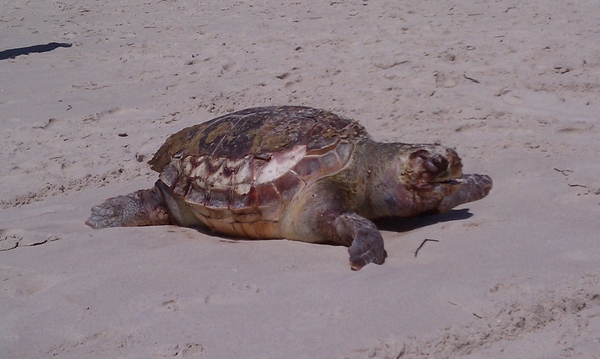
Sunbathers at both Rogers Beach in Westhampton Beach and Flying Point Beach in Water Mill got a surprise as they strolled the shoreline on Wednesday and found loggerhead sea turtles that had washed up onto the sand.
Neither sea turtle was alive.
New York City resident Irene Conway was heading west along the coastline from Rogers Beach to meet her daughter Eleanor, 16, at approximately 11 a.m. when she saw something that caught her attention on the beach.
“It looked like a big rock at first,” she said. “It was huge. I don’t do that well in the sun and heat, and at first I thought I was hallucinating. I thought, ‘That looks like a turtle.’ Then I realized it
was
a turtle.”
According to Kimberly Durham, the rescue program director and a biologist at the Riverhead Foundation for Marine Research and Preservation, what Ms. Conway witnessed wasn’t a heat-induced apparition. Instead, it was a female loggerhead sea turtle, approximately 3 feet long and weighing 70 pounds, indicating the animal was still a juvenile. Loggerhead sea turtles, Ms. Durham added, can grow to approximately 300 pounds.
“She was one of two sea turtles we picked up,” on Wednesday, Ms. Durham said. The second sea turtle, found at Flying Point, was also a juvenile loggerhead, and was approximately 45 to 50 pounds.
An autopsy on the Rogers Beach sea turtle indicated that the animal was in very good body condition, Ms. Durham said, with food throughout its gastrointestinal tract, but with some hemorrhaging. “In my opinion, she fit the profile of an animal that might have been a by-catch in an offshore fishery and then washed ashore.”
Animals that do not appear sick, and that have fat reserves and appear to have been caring for themselves, often die “acutely,” Ms. Durham said.
Although the autopsy revealed a fragment of latex balloon and a piece of plastic in the sea turtle’s stomach, neither appears to have had anything to do with the animal’s death, Ms. Durham said.
Based on the fact that sharks had not yet touched the sea turtle, Ms. Durham estimated that it had been dead only about a week.
Despite the fact that the discoveries sparked a stir among beachgoers, Ms. Durham said sea turtles are common in the area. Loggerheads are one of four species, including Kemp’s ridley, leatherback, and green sea turtles, found in area waters.
Loggerheads, Ms. Durham added, usually start appearing in June, when waters warm up, and start migrating south in October. “We have a nice population here,” she said.
Typically, loggerheads eat crustaceans, including hermit crabs and whelks, Ms. Durham noted.
Each year, approximately 50 to 65 sea turtles from all the species are found dead on area shores. Although fishery interaction is to blame for some accidents, other causes of death include boat strikes and shark attacks. Approximately 20 sea turtles have been found this year. “The numbers aren’t elevated,” Ms. Durham said.
Should numbers spike, further investigation would be needed to determine the cause of death. Currently, Kemp’s ridley sea turtles are endangered and loggerheads are threatened. Discussions have been held about possibly elevating the status of loggerheads, whose numbers are depleting, to endangered, but a decision has not yet been made.
Sun seekers at both beaches called the Riverhead Foundation. The first call, about the Flying Point loggerhead, came in at approximately 7:15 a.m., Ms. Durham said. A team of two members was sent to collect the first sea turtle as calls came pouring in regarding the second, on Rogers Beach.
“Everyone was calling,” Ms. Durham said, adding that the foundation truck was sent from Southampton to Westhampton Beach to pick up both animals as frantic calls continued. “It was a gorgeous day and, the Hamptons being the Hamptons, let’s be honest—no one wants dead things on the beach.”
Ms. Durham thanked the “extremely helpful” lifeguards who aided efforts.
For Ms. Conway, it was a day she won’t soon forget. “I thought I was on another planet,” she said. “I never imagined I’d see such a big turtle on the beach. I thought he had landed from space.”
Anyone who finds a stranded animal should call the foundation hotline at 369-9829, Ms. Durham said, adding that finding animals on the beach is not uncommon. Each year, the foundation rescues, rehabilitates, and releases seal and sea turtles. In fact, a seal release is scheduled for Tuesday at Ponquogue Beach in Hampton Bays. “Some of them are good stories. This one wasn’t,” she said.


