


 6 Photos

Samples of the pies. DANA SHAW

President Donald Trump’s executive order last week to temporarily bar refugees and immigrants from seven Middle Eastern nations was a necessary and reasonable step to protect Americans from potential terrorists, U.S. Representative Lee Zeldin said this week.
The move drew outcry from across the nation and sent attorneys, including at least one local lawyer, scrambling to airports to help hash out the legal implications for those caught in the limbo created by the hastily implemented order.
Mr. Zeldin said that shortcomings in the ability of American officials to conduct thorough background checks on those applying for visas to come to the United States have long left the system vulnerable to manipulation.
“These countries were chosen for a reason—they are destabilized, and there is little to no documentation to rely on when you are trying to determine who someone is and what their beliefs may be,” Mr. Zeldin said in a phone interview on Monday. “You’re just relying on what someone tells you. The president is interested in gaining a better grasp on the current reality of the process. He wants to strengthen whatever vulnerabilities there were in the past.”
Mr. Zeldin said that during his first term in Congress he became familiar with the failings of the immigration background check system and saw that it needed to be improved. He said he also came to believe that halting immigration approvals temporarily while improvements are made may be necessary.
He offered some suggestions for how the system could be strengthened during the 90 days of the immigration freeze dictated in the executive order, including releasing surplus screening and identification equipment warehoused in the United States to the countries on the banned list—something that is proposed in a bill he authored called the Counterterrorism Screening and Assistance Act. The act is before the congressional Committee on Foreign Relations.
The congressman, who started his second term in office last month, acknowledged that the executive order issued Friday could have been presented better in terms of preparation and communication with the people at airports who would be expected to enforce it. From Friday night through Monday, more than 150 people were detained at airports around the country because they had flown to the United States before the order, which took effect immediately, had been issued.
“I think if there was better communication down to the individuals responsible for implementation and better direction of what the exceptions were to be, you would have had fewer people being detained as long as they were,” he said. “Better communication is going to always be important.”
Among those detained at airports was a Stony Brook University student, Vahideh Rasekhi, an Iranian Ph.D. candidate and president of the school’s graduate student organization, who was returning from Iran on a student visa. Mr. Zeldin said she was released and allowed to return to Long Island on Monday.
Around the country attorneys flooded to airports to halt what had initially been a policy of informing those who had lost their immigration privileges while en route that they would have to return to their home country, and subsequently to help those being detained to navigate the review process.
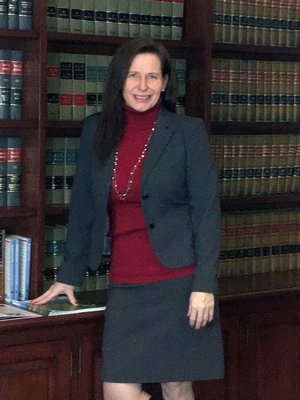
East Quogue resident Melissa Sidor, an attorney and partner at Twomey Latham Shea Kelley Dubin & Quartararo, was one of those who answered the call for legal assistance at the airports.
“I was at the bakery with my kids when I heard about this call for attorneys,” Ms. Sidor said. “I said to them, ‘I think I have to go to JFK,’ and they said, ‘You go, Mom!’”
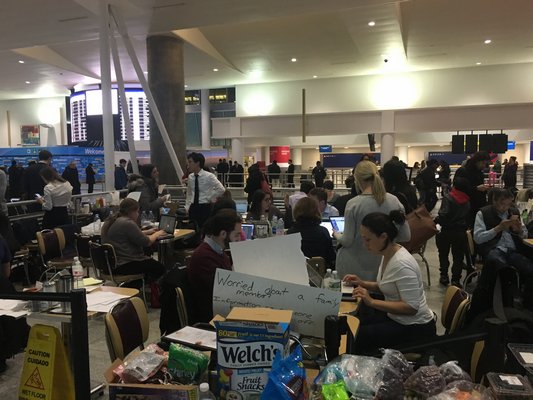
Ms. Sidor said she served over the weekend primarily as a go-between for the crowds of dozens of lawyers camped out in JFK’s Terminal 4 and New York’s two senators, Kirsten Gillibrand and Chuck Schumer. Similar teams of attorneys were stationed in other JFK terminals as well as at airports nationwide.
“We’re getting information from the families of the people who were being held, so we didn’t know the totality of how many there were,” she said. “We don’t know how many people were being held that didn’t have family members there to meet them to alert us. A couple got sent back before the judge’s order as I understand, told that if they didn’t leave voluntarily they would be deported and that then they couldn’t apply for a visa again.”
Opponents of the executive order have noted that no immigrant from any of the countries on the list has ever killed someone in the United States—although a Somali student did wound three people at Ohio State late last year and Iranian and Somali immigrants have participated in other non-fatal attacks or been arrested for planning one. The countries of origin of those who have killed the most Americans, primarily the four countries where the September 11 hijackers hailed from, are not on the list.
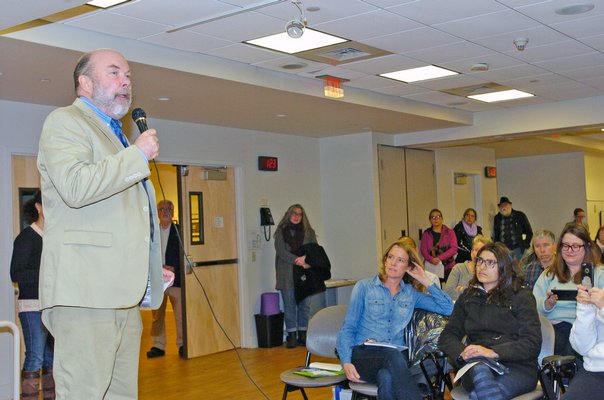
On Tuesday, dozens of outraged East Enders stuffed into Mr. Zeldin’s Riverhead office to voice their objections to the order and his support of it. Among them was Ken Dorph, a Sag Harbor resident who works as a banking and financial markets consultant to the World Bank in the Middle East.
“This is a horrible thing for business—business needs the free movement of people,” said Mr. Dorph, who has worked frequently in Iraq. “This kind of mentality of pulling up the drawbridges of the world inevitably leads to economic stagnation.”


 on Jan 31, 2017