


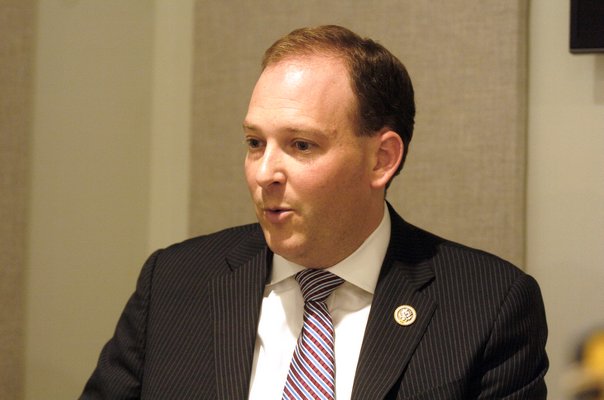
 1 Photo

U.S. Representative Lee Zeldin’s legislation to amend the process by which financial institutions prepare for possible calamity sailed through the House of Representatives unanimously last week.
On Tuesday, January 30, the House passed the “Financial Institution Living Will Improvement Act” by a vote of 414-0, with 16 members not voting. The legislation intends to amend Title I of the Dodd-Frank Wall Street Reform and Consumer Protection Act, passed in 2010, which spells out the process by which financial institutions—mostly large banks—must create a “living will,” also referred to as a resolution plan.
A living will, which is required of financial institutions with at least $50 billion in consolidated assets, ensures that in the case of financial disaster the institution’s bankruptcy won’t trigger a systematic collapse, according to the Federal Reserve’s website. This part of the Dodd-Frank Act has roots in the 2008 financial crisis and is an attempt to insulate one bank’s failure from the rest of the financial system.
In its original form, the process of creating a living will for a multibillion-dollar institution was a laborious undertaking. Per the Dodd-Frank Act, the will must include steps the bank can take to quickly liquidate or restructure in the event of bankruptcy; give regulators clear information about the bank’s structure and any international operations; and include money to fund critical operations during the liquidation or restructuring.
Institutions must submit these wills annually to regulators from the Federal Reserve and Federal Deposit Insurance Corporation, and can face sanctions if they don’t produce a reasonable will after two attempts.
The process of drawing up the will must include people with knowledge of corporate, tax and insolvency law, and there is no template for the document, since each institution has a different and constantly evolving risk profile, according to a report from the Practical Law Company.
Mr. Zeldin’s bill seeks to lessen the strain of this process on the financial institutions. Instead of annually updated living wills, the Living Will Improvement Act requires an update only every two years. It also requires the regulators at the Federal Reserve and Federal Deposit Insurance Corporation to return feedback on the wills within six months, and to publicly disclose the rubric they used to assess them.
“This may sound like wonky financial policy, but to a person on Long Island trying to get a small-business loan or mortgage, improving the living wills process ensures that the community banks that they rely on can focus on lending to their customers, instead of wasting their resources complying with an arbitrary set of confusing regulations,” Mr. Zeldin said in a press release.
The bill was co-sponsored by Democrat Representatives Carolyn Maloney of New York and Krysten Sinema of Arizona, and Republican Representative Edward Royce of California.
According to Mr. Zeldin’s communications director, Katie Vincentz, the congressman’s team is confident that the bill will garner enough support to pass in the Senate. She added that the Senate Banking Committee is currently working on banking reform legislation, and that Mr. Zeldin’s act may be rolled into that, with a vote to be taken later this year.


 Kate Riga on Feb 1, 2018