


 2 Photos
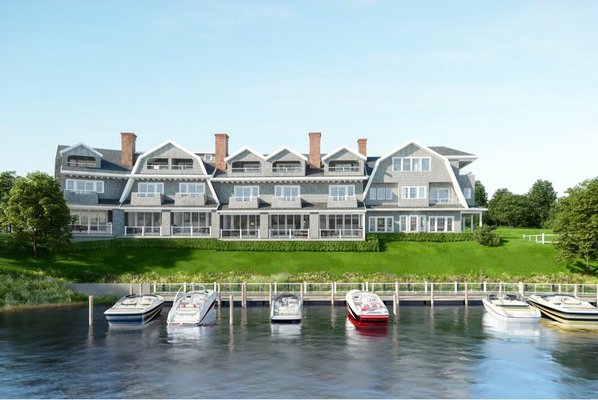
A rendering of what the townhomes will look like once complete. COURTESY GREG GORDON
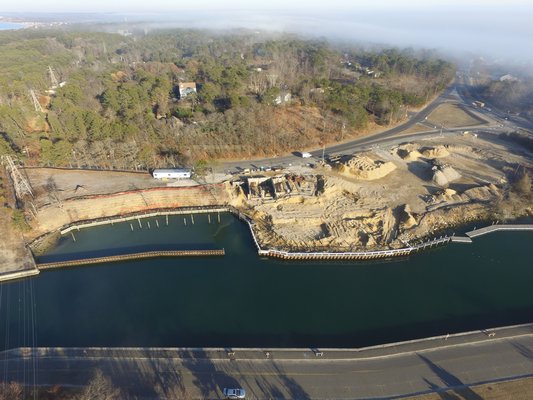
Assistant Town Planning Director Janice Scherer said that the developer’s removal of five trees near the former Tide Runners building was not authorized and has caused slumping and divetts along the site’s northern bluff.
The unlawful clearing of vegetation along the eastern side of the Shinnecock Canal—as part of a $110 million project to restore the former Canoe Place Inn—has raised concerns among Southampton Town officials.
At a recent Southampton Town Planning Board work session, Assistant Town Planning Director Janice Scherer said that the developer’s removal of five trees near the former Tide Runners building along the canal in Hampton Bays was not authorized and has resulted in slumping and divots along the site’s northern bluff.
She said an on-site meeting should have been held between the developers and the town to discuss the plans prior to the disturbance, noting that she was not apprised of any excavating work until January.
Terry Contracting—hired as a subcontractor by Racanelli Construction Inc., the project’s lead contractor—began clearing the site in December. “We didn’t even know,” Ms. Scherer said.
At the January 24 meeting, Planning Board member Robin Long recommended holding another work session with Ms. Scherer and representatives of Rechler Equity Partners, the developers behind the project, to discuss the breakdown in communication, as well as finalize remediation plans for the site.
The developer has not disputed that the clearing was done in error.
“This was our mistake,” Andrew Renter, the Rechlers’ director of development and construction, said at the meeting. “We are committed to doing whatever mitigation the town deems necessary.”
He explained that plans to clear the site were divided into three phases in order to protect the landscape throughout the course of the year-long project and admitted that the contractor essentially got ahead of themselves. He noted that site superintendents for Racanelli Construction and Terry Contracting—neither of whom were on site during the disturbance—were advised of the plan.
“It came down to the guy in the machine,” he said, adding that the areas of phase two and three have now been fenced off. “He thought it would be a good idea to clear it all at once and went too far.”
Steven Nieroda, a landscape architect with Araiys Design, who was hired by the developers to render mitigation plans, said that steps have been taken to stabilize the slope and prevent any further erosion. Contractors have installed temporary batter boards parallel to the property’s contours to act as temporary root systems, as well as laid dune mesh along the slope.
He recommended building a stone retaining wall near the north end of the site—the steepest portion—to prevent subsequent damage; however, those plans have not yet been approved by the town. Any mitigation plans such as re-vegetation and planting would also need to be approved by the State Department of Environmental Conservation.
The Town Board approved the developer’s plans to build 37 townhomes on the 4.5-acre property in 2017 in exchange for the restoration of the former Canoe Place Inn on the Rechlers’ 5.6-acre parcel to the west.
To prevent similar situations from occurring in the future, at the meeting, Planning Board Chairman Dennis Finnerty advised Mr. Renter and his colleague, Kristin McCabe, to assign a full-time site manager to monitor the work being done. “A project of this size requires a full-time site engineer to run out and say ‘stop’ if this happens again,” he said.
In a prepared statement on Thursday, Gregg Rechler, who co-owns the property with his cousin Mitchell, said that Mr. Nieroda has already submitted a restoration plan to the town for review.
“We are fully committed to working with the town to correct this unfortunate error,” he said.


 Valerie Gordon on Jan 31, 2019