


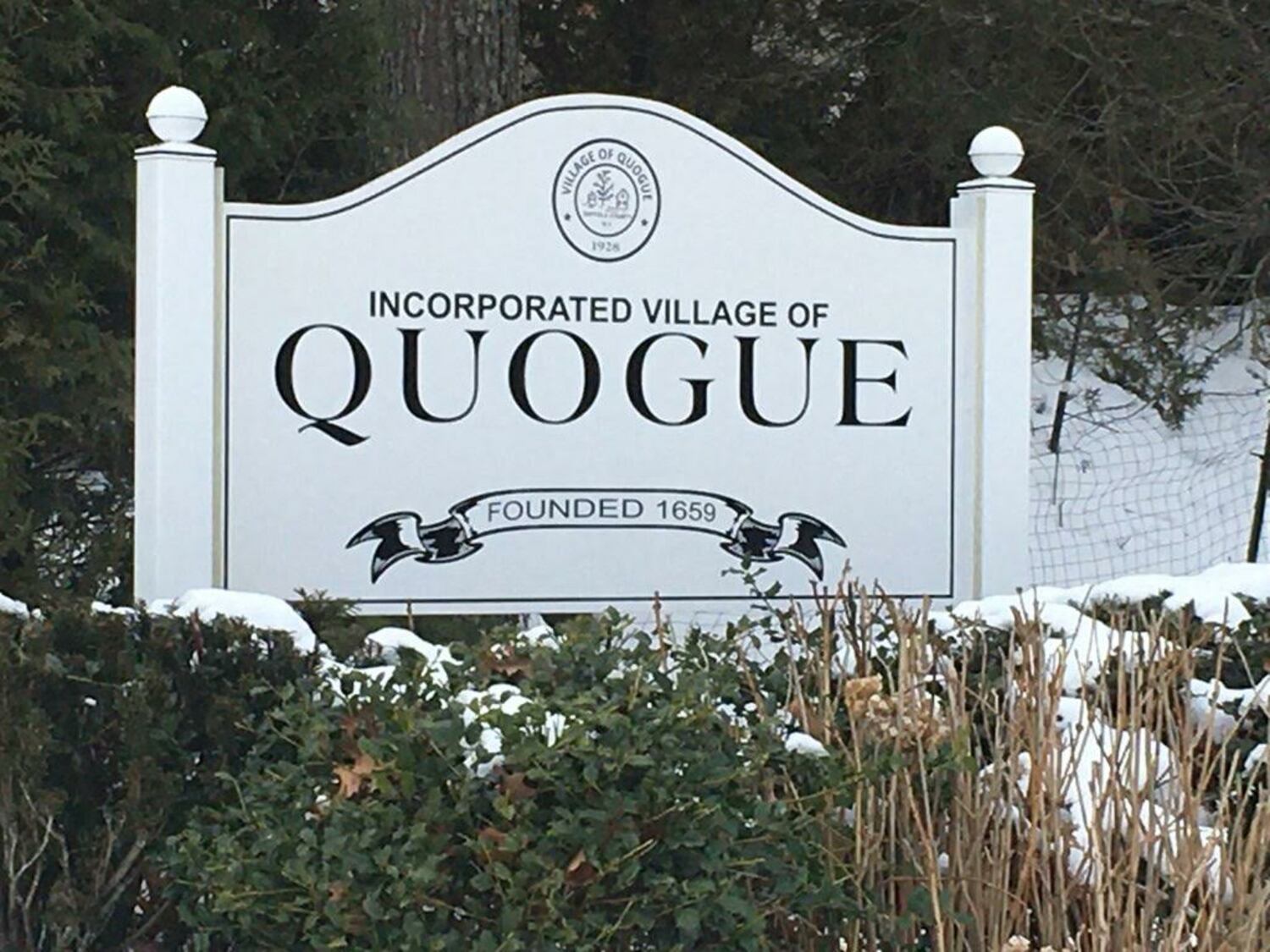
 1 Photo
The Village of Quogue is 95 years old. Happy anniversary. KITTY MERRILL
Carrying on the tradition established by his predecessor, Peter Sartorius, Quogue Village Mayor Robert Treuhold periodically sends out a mass email to residents. It speaks of upcoming events and ongoing projects, and this week, made note of a milestone.
On May 12, the village celebrated the 95th anniversary of its incorporation.
The mayor offered some history: “On this day some 364 years ago, the Village of Quogue was established upon the purchase by John Ogden of a vast parcel of land stretching from Canoe Place to the east (now the Shinnecock Canal) to Beaverdam Stream to the west (now Westhampton) and extending 3 miles north from the high water mark,” he wrote.
“Fast forward to 1928, when some of our very astute residents had the good sense to incorporate our village thereby giving us much more control over our destiny,” the mayor continued, concluding with, “Happy 95th anniversary!”
In 1659, the Quogue purchase was the second important purchase of Native American lands by English settlers, according to the Quogue Historical Society website.
Settlers who made that first purchase — Southampton in 1640 — quickly realized the value of the broad natural salt marsh meadows near Quogue for grazing their cattle, oxen, swine, and sheep. There was an added asset: Quogue offered direct access to the beach for fishing and whaling.
Wyandanch, the sachem of the Montaukett tribe, signed the deed, which was witnessed by his friends, Lion Gardiner and his son, David, of Gardiner’s Island.
Some 400 pounds were paid. According to a table crafted by a consultant with the Bank of England, a pound back then would have the buying power of 66 pounds in present day. Doing the conversion to dollars, the settlers paid an amount that would be equal to $26,400 in 2023.
The purchase allowed Native Americans to retain fishing and hunting privileges, according to the historical society narrative.
The first building was constructed by John Foster during the early 1700s. He built it for his shepherd, so he wouldn’t have to make the trek back to Southampton Village at the end of the day’s work.
“Miraculously, the building survives today and is a private residence known as Old Revolution. Sheep’s blood has been found on a number of its beams,” the historical society’s history informs.
Native Americans called the area Quawquannantucke,or Quaquanantuck. Coagg is the earliest record of a single syllable abbreviation of the name, with others Quago, Quag, Quoag, Quagga — and, finally, Quogue.
Nowadays, according to the website newyork-demographics.com, the 2020 census lists the village population at 901, with a median income of, in 2021, $134,063 and an average age of residents of 58.6 years.


