


 6 Photos
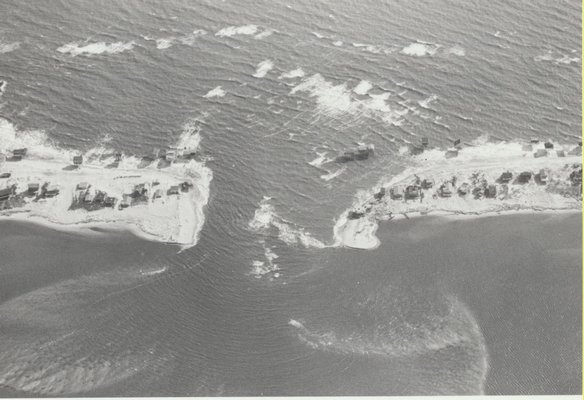
The newly created inlet in West Hampton Beach in 1993. PRESS FILE

The rebuilding of West Hampton Dunes in 1994 PRESS FILE

West Hampton Dunes homeowners in 1993 at Little Pikes Inlet. PRESS FILE

The rebuilding of West Hampton Dunes in 1994. PRESS FILE

The rebuilding of West Hampton Dunes in 1994. PRESS FILE

Gary Vegliante in West Hampton Dunes in January of 1993. PRESS FILE
Twenty years ago, 80 percent of the homes that make up what is now the Village of West Hampton Dunes had toppled into the Atlantic, not much more than matchsticks when facing the pounding nor’easters and an ever-widening breach on the barrier island. The few homes left standing once the skies cleared were virtually worthless.
After the storms, residents stood on the eastern edge of the mile-wide “Little Pikes Inlet,” as they dubbed the breach that tore their oceanfront neighborhood in two, unable to reach their properties without the help of a boat.
Today, as they prepare to celebrate the 20th anniversary of their village’s incorporation—the vote to incorporate was in November 1993, though the village was not officially established until January 1, 1994—homeowners still recall with awe how they defied the ocean’s destructive forces. They are also celebrating how they transformed what Mother Nature had laid to waste into a bustling vacation community lined with multimillion-dollar homes.
The fact that their community exists, however, is no accident as it was the result of years of hard work and litigation.
Homeowners blamed the destruction of their homes in the early 1990s on the U.S. Army Corps of Engineers, which, in the 1960s and 1970s, installed jetties along the barrier island and to the east of West Hampton Dunes. They insisted that the stone jetties trapped sand, causing devastating erosion further west that was exacerbated by a series of severe storms between 1991 and 1993.
But with close to a million dollars in legal fees racked up in a decade-old lawsuit against Suffolk County seeking damages for the devastation of their neighborhood, the future looked bleak.
“It was never our fault—this is not natural erosion,” Mayor Gary Vegliante said earlier this week, recalling the events.
He explained that as a homeowners association called the Barrier Beach Preservation Association, the group had little clout in the courts. The government’s strategy, he said, was to “beat them through attrition.”
But in November 1993, the tide turned. The residents had banded together to complete the process of incorporating as an independent village, with the help of then-Southampton Town Supervisor Fred W. Thiele and attorney Joseph Prokop. With a stronger financial footing, and more legitimacy as a municipality, the homeowners were able to then force the federal, state and county governments, all three named defendants in the suit, to pay for an $80 million beach restoration plan, including 30 years of nourishment and maintenance.
“At the time we decided to incorporate, we were in the throes of despair,” said Mr. Vegliante, who has been the only mayor in the village’s history. “It was really a successful thing to do, and it really brought us back to life.
“All we wanted was the right to return to the properties and rebuild our homes,” he continued.
At the time, much of the barrier beach was laid to waste as, in addition to the homes, the roads and utilities had been washed away by the ocean. Even as the massive beach rebuilding project got under
way in 1996, many brushed it off as folly, according to coastal geologist Aram Terchunian, who has been intertwined with the village since its establishment. He pointed to a New York Times article published in 1996—about two years before the beach rebuilding work was completed—that quoted Duke University geology professor Dr. Orrin Pilkey as having described it as a “futile effort” that he would stake his reputation on failing. “It’s not going to work,” Dr. Pilkey told The Times at the time.
“Even after [the breach] was filled, it was a flat area of sand that looked more like a desert than a thriving community,” added Mr. Thiele, now a state assemblyman.
Still, Mr. Terchunian, of the First Coastal Corporation in Westhampton Beach, said he was confident in the science behind the design of the project from the start. It was proven, he said, though seeing it realized was a different matter.
“In this business, it’s all the ability to hold your breath,” he said. “Being right is wonderful, but if you can’t survive, if you don’t have enough resources to complete the mission, then it’s over.”
In 1997, as the restoration project neared completion, reestablishing a beach hundreds of feet wide with dunes as tall as 15 feet, the village boomed. Property values sky-rocketed from less than $10,000 per parcel to millions, and the population jumped.
Mr. Vegliante can still recall the name of the property owner who applied for the first building permit from the village in 1995—a man named Jeffrey Doremus. “They couldn’t wait to get back out here,” he said of the property owners. “They had real guts.”
The mayor estimated that less than 10 percent of the original homeowners still live in the thin strip of sand that is West Hampton Dunes. The Village Board now consists of Renee Brown, whose husband, Charlie Brown, was a member of the original board, along with Gary Trimarchi, Catherine Woolfson and Michael Craig.
“I don’t think that anyone could have foreseen that West Hampton Dunes would succeed as well as it did,” Mr. Thiele said on Tuesday. “It was hard to imagine that all would go as well as it did.”
He said that as town supervisor, he was supportive of the quest of homeowners to incorporate, viewing it as the only way they could have a sliver of a chance at saving their community. The town, he said, could not have given the issue the focus that it needed, and he recognized that fact, despite the threat of losing the thousands in property taxes annually. The assemblyman recalled the village’s first election, which was held in a tent due to the lack of stable buildings along the battered stretch of Dune Road.
The village’s success, Mr. Thiele added, is largely a tribute to the leadership of Mr. Vegliante and the other trustees. On Saturday, September 7, starting at 1 p.m., the village is hosting a barbecue at Pikes Beach—which, ironically, was the site of the breach—to celebrate its 20th anniversary of incorporation. At the event, Mr. Thiele will present village leaders with a proclamation, commending them for their tenacity.
The Barrier Beach Preservation Association, which exists today as a nonprofit dedicated to preserving the ecology of Moriches Bay and the ocean beaches, will host a 5K race that same day, with registration beginning at 7 a.m. and the race kicking off at 9 a.m.
“I fully expect to be there with a great big smile on my face,” Mr. Terchunian said of the celebration.
Even as the future threatens storms of increasing strength and frequency, as Hurricane Sandy warned, the geologist said he is confident about the future of West Hampton Dunes. The village suffered little more than lost shingles in last fall’s “superstorm,” noting that the storm also caused a “minor overwash” just to the east of Pikes Beach.
The village’s total property value, meanwhile, has jumped from about $300,000 in the early 1990s to three quarters of a billion dollars today, according to the mayor.
“Those are the kinds of metrics I look at,” Mr. Terchunian said, adding that the restored beach and dunes have performed far beyond the standard that he predicted. “They’re mind-blowing.”
Mr. Thiele and Mr. Terchunian said West Hampton Dunes is a model for other communities along the coast that are threatened by storms and erosion, including the communities of Bridgehampton, Water Mill and Sagaponack that have formed an erosion control district to fund a massive beach nourishment project that is set to get under way later this month. Earlier this summer, the federal government approved $700 million in funding to rebuild the beaches along the South Shore from Fire Island to Montauk as part of a project called the Fire Island to Montauk Point Reformulation Study, or FIMPS.
“I think that the lessons that were learned from West Hampton Dunes will be lessons that will benefit the entire shoreline,” Mr. Thiele said.


 Carol Moran on Sep 4, 2013