



 5 Photos
Westhampton Beach officials are opposing a plan that would shorten the rock jetties on municipal beaches. BY ERIN MCKINLEY
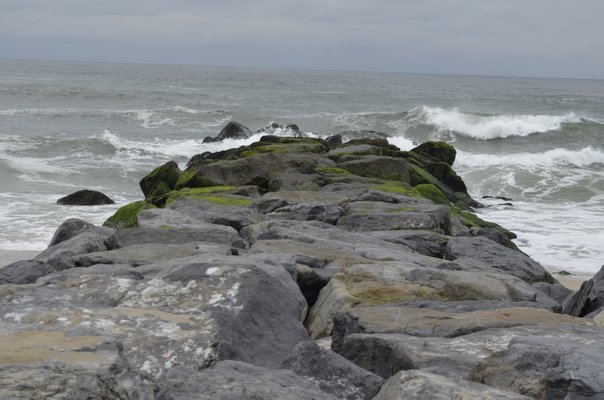
Westhampton Beach officials are opposing a plan that would shorten the rock jetties on municipal beaches. BY ERIN MCKINLEY

Westhampton Beach officials are opposing a plan that would shorten the rock jetties on municipal beaches. BY ERIN MCKINLEY

Westhampton Beach officials are opposing a plan that would shorten the rock jetties on municipal beaches. BY ERIN MCKINLEY

Westhampton Beach officials are opposing a plan that would shorten the rock jetties on municipal beaches. BY ERIN MCKINLEY
Westhampton Beach Village officials said this week that they will oppose plans pitched by the U.S. Army Corps of Engineers that would shorten nearly a dozen rock jetties in the village, a move that the federal agency said is needed to curb erosion at beaches to the west.
The proposal is a part of the draft 400-page Fire Island to Montauk Point Reformulation Plan, commonly referred to as FIMP, a document that has been circulated and tweaked for decades, and whose main goal is to slow erosion and fortify the South Shore of Long Island. The public comment phase is set to expire in mid-October, with the completed plan scheduled to be released sometime next year.
FIMP recommends shortening the village’s 11 jetties, also known as groins, as well as four nearby ones that are within the Town of Southampton, all part of the Westhampton Groin Field. Currently, 13 of the groins are 480 feet long, while the last two are 417 and 337 feet long. The Army Corps wants to reduce the length of eight of them to 380 feet, while the others would either be 410 feet or 386 feet long.
The modifications, which are expected to cost $426,754 per jetty and be covered by the federal government, has the potential for a one-time release of more than 500,000 cubic yards of sand that would eventually settle to the west of the village, according to the Army Corps.
Westhampton Beach Mayor Maria Moore said she is worried that the shortening of the groins, if approved, will cause erosion on her village’s beaches.
“They are stressing that this is not the final report, and they are going to do a more detailed design in the next phase of their analysis,” Ms. Moore said this week. “But we wanted to make sure we get our position in early enough that they would consider the impacts of their actions on our beachfront.”
The primary goal of FIMP is to increase the amount of sand deposited on beaches to improve Long Island’s ability to withstand future storms. Other portions of the plan include dumping 1.5 million tons of sand onto beaches in East Quogue and Hampton Bays to fortify them, and shoring up the coast of Montauk to the east.
According to experts, jetties help curb beach erosion by blocking strong currents and riptides from scouring away sand from the shoreline—though their actual effectiveness has been debated for decades. The Westhampton Groin Field, as the area has been dubbed, was created between 1965 and 1969 and spans about 2.8 miles of beach. The original plan also called for the installation of eight additional groins in what is now the Village of West Hampton Dunes; that work was never completed for reasons not immediately clear.
The draft FIMP notes that the groin field has done a good job in protecting the area from erosion and flooding. The hardened structures, however, have been blamed for causing erosion to the west, and some point to the 1992 breach of the barrier island in the Village of West Hampton Dunes as evidence to that theory.
Ms. Moore said her village has retained local environmental firm First Coastal Corporation of Westhampton Beach to review details of the federal document that would specifically impact Westhampton Beach.
“The Army Corps has studied the area and determined it would not have an adverse safety impact on the homes and properties in Westhampton Beach,” Ms. Moore said. “But that is why we asked them for a more detailed analysis on that because it seems counterintuitive to us if that would be the case.”


 Erin McKinley on Sep 28, 2016