


 1 Photo
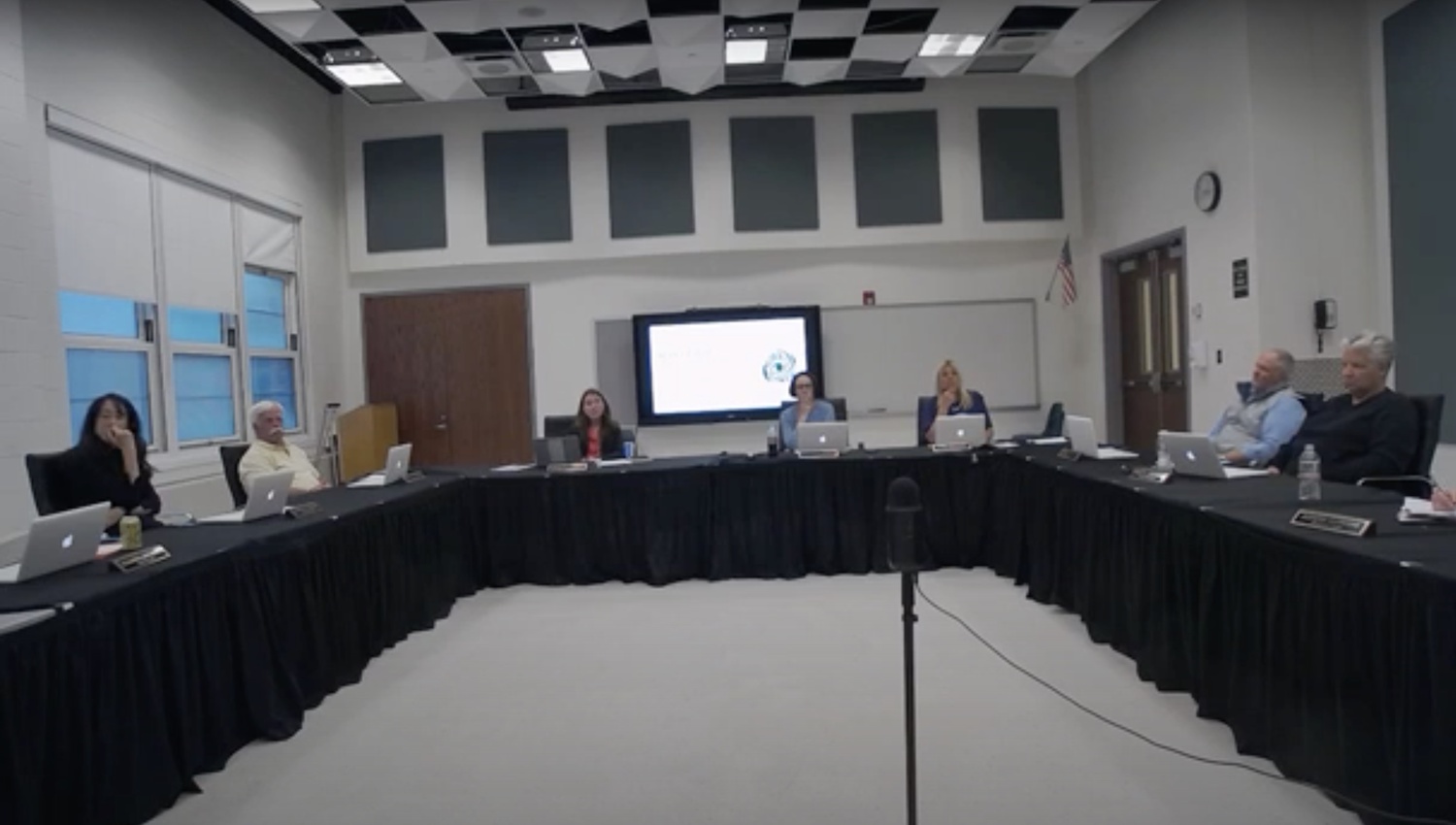
Westhampton Beach Superintendent Dr. Carolyn Probst and the board of education present the proposed spending plan for the 2023-24 school year during a May 8 budget hearing.
The Westhampton Beach School District is asking residents to vote Tuesday, May 16, on a proposed $62,994,351 budget for the 2023-24 school year.
That spending plan, a 2.36 percent, or $1,450,057 increase in spending from this current year’s, comes with a $33,584,341 proposed tax levy, a 2.24 percent, or $734,954 increase that is compliant with the tax levy cap.
And Superintendent Dr. Carolyn Probst said during Monday night’s budget hearing that it was brought into compliance despite 14.73 percent employee retirement system, 10 percent utilities and 8.75 percent health insurance rate increases, among others. Under year 12 of the property tax cap, the district only had a 2.36 percent allowable budget increase.
“It’s a mathematical equation that doesn’t have an easy answer,” Probst said. “Each year, we feel not only the constraints of this year’s cap, but really, the cumulative toll of all of the caps of previous years, as well. In addition to that, this year, we are facing increasing costs and declining enrollment. In spite of those challenges, which are not unlike what many of us are feeling in our homes, the proposed budget is in compliance with the tax levy cap.”
For the current school year, a home assessed at $750,000 pays around $4,534.73 in school taxes. A home with the same valuation is estimated to see a yearly upsurge of $101.54, which equates to an approximate $8.46 increase per month.
The three-part budget breakdown shows programs make up more than three quarters of the budget, costing $45,456,464. The capital budget, which encompasses everything it takes to run the physical buildings, including equipment and supplies, totals $11,316,510, and the administrative budget, or back-office functions, cost $6,221,377. Of the projected expenditures, 52 percent are salary-based, while 23 percent cover benefits, 7 percent debt service, 7 percent contractual, 4 percent transportation and 2 percent Eastern Suffolk BOCES costs.
To offset this, property taxes and payments in lieu of taxes make up 54 percent of projected revenues, while tuition fees make up another 38 percent. The district has also been removing positions, mainly through attrition, and largely due to declining enrollment at the kindergarten level, which is beginning to work its way up through the other buildings.
Probst said she is anticipating an incoming cohort of roughly 40 students for the 2023-24 school year, a number that is far off from what is “pretty steadily in the 60s,” according to the superintendent. The overall number of incoming kindergarteners has dropped from 58 to 53 to 50 this current school year.
“Kindergarten registration is ongoing and will happen throughout the summer, but as of today we have 31 students registered for kindergarten, which is significantly lower than where we have been in previous years at this point in time,” Probst said. “It’s a little bit of a moving target, however typically by this time in the year, we’ve seen about 80 percent of our cohort has registered.”
Elementary school registration, hovering around the 370s, saw a spike to 401 during the 2020-21 school year, attributed to the COVID-19 pandemic, and had steadily dropped since to an expected 345 for next school year.
Through retirements, the district has reduced its clerical staff by two and music teacher and groundskeeper departments by one each, along with losing a kindergarten through sixth grade teacher, and the district may cut up to three more teachers should the decline in enrollment trend continue. The superintendent said the cohorts will most likely not require the same number of sections.
“In the spirit of honesty and transparency, I think it’s important to talk about. And even in the face of those difficult points, I will say that we won’t take our focus off what is most important, which is the students that walk through our doors every day,” Probst said. “Even in a difficult budget year, this budget maintains and expands upon programs and curriculum initiatives.”
There are also some proposed capital improvement and renovation projects within the operating budget, which include exterior door replacement at the elementary school, concrete repairs at the middle school and replacement of a water-reduced pressure zone, or RPZ — valve into the high school. Also included is districtwide heating and HVAC repairs, electrical updates, septic tank repairs, building and grounds fencing, gym partition door replacements, building management system reconfiguration, flooring repairs and signage. These are separate from a bond proposition approved by voters in the fall for larger projects, including the replacement of the turf field and track, school building roofs and windows.
Along with the budget, district residents will be asked to approve a second proposition, a $2,550,193 library levy. The levy is a $77,835 increase from last year’s $2,472,358, and $558 below the cap. On a house assessed at $500,000, this would cost an estimated $233.58 per year, or $19.46 per month. This results in a difference of $6.08 per year, or $0.51 per month.
At the same time, the annual trustee election will take place. Board of Education members Halsey Stevens and Heather Wright are running unopposed to retain their seats for three more years.
The budget vote and trustee election will be Tuesday, May 16. Voting will take place from 7 a.m. to 9 p.m. in the high school’s large group instruction room.


