


 3 Photos
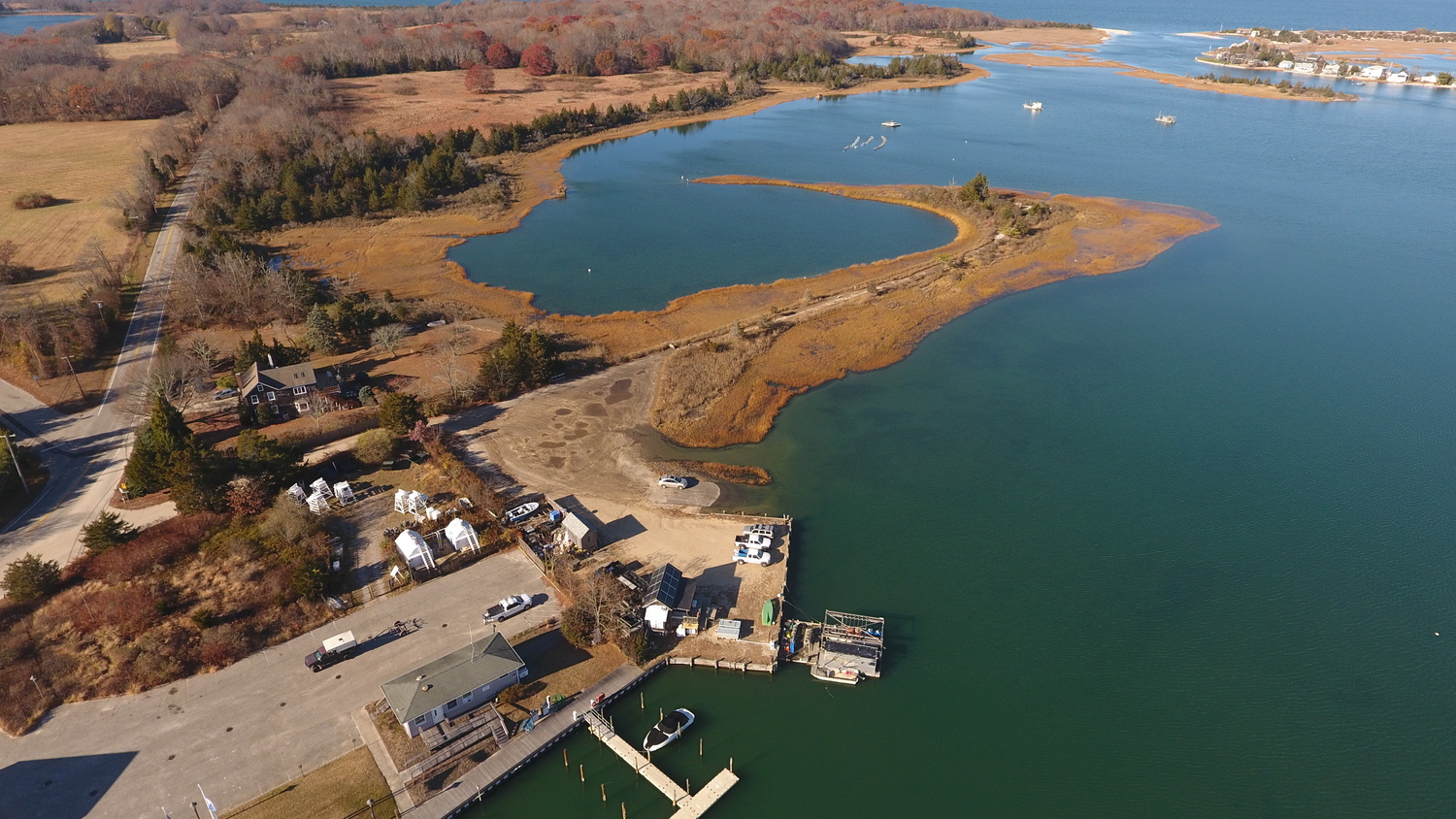
The Southampton History Museum has owned Conscience Point since 1910, which it dedicated shortly thereafter as the honorary landing point of English settlers on Long Island in 1640. But representatives of the Conscience Point Shellfish Hatchery say they have found documents that seem to indicate the museum does not in fact own the southern portion of the property that contains the the Southampton Town Trustees boat ramp and the small hatchery building. MICHAEL WRIGHT
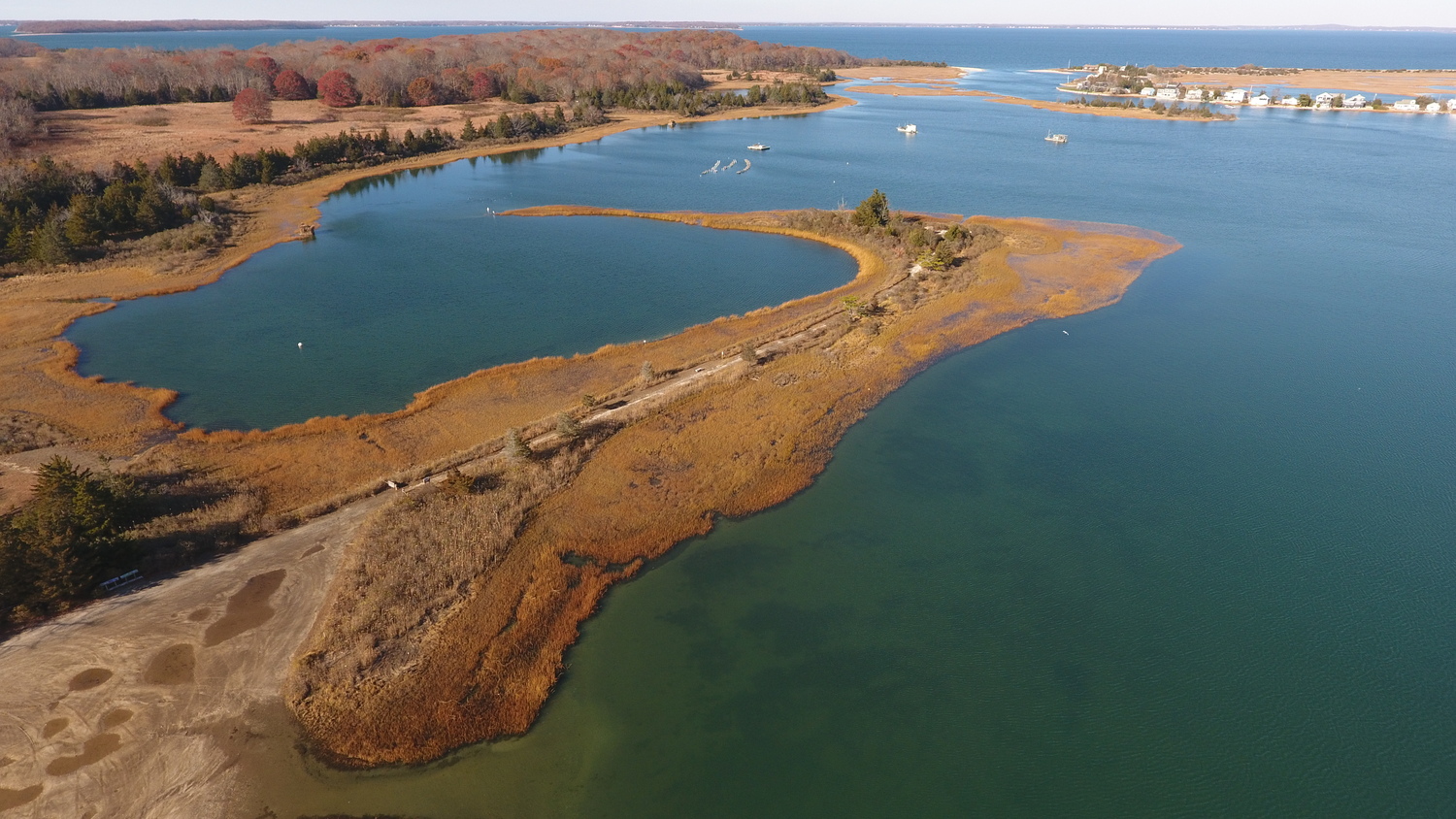
The Southampton History Museum has owned Conscience Point since 1910, which it dedicated shortly thereafter as the honorary landing point of English settlers on Long Island in 1640. But representatives of the Conscience Point Shellfish Hatchery say they have found documents that seem to indicate the museum does not in fact own the southern portion of the property that contains the the Southampton Town Trustees boat ramp and the small hatchery building. MICHAEL WRIGHT
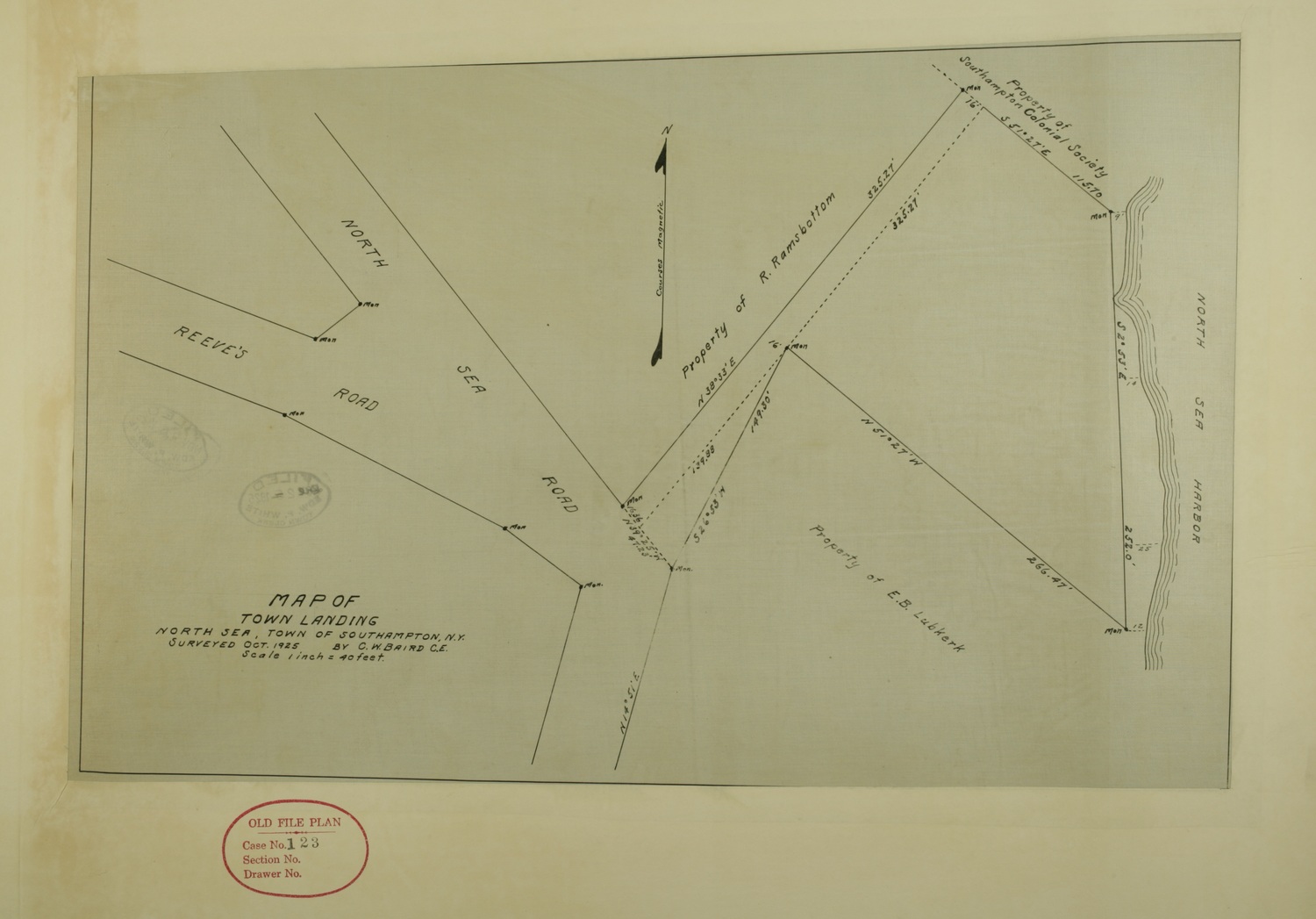
A surveyors map from 1925 shows the Conscience Point property being two separate parcels, one owned by the town and the other by the Southampton Colonial Society. Representatives of the Conscience Point Shellfish Hatchery plan to use the deed as evidence that the Southampton History Museum cannot evict the hatchery. COURTESY TOWN OF SOUTHAMPTON
On the eve of a court hearing on whether the Southampton History Museum can evict the Conscience Point Shellfish Hatchery from the corner of a dirt parking lot that the hatchery has leased for the past decade, the Southampton Town historian revealed that she has found century-old deeds and documents that would seem to indicate the museum may not, in fact, own the land the hatchery sits on.
The land that has since the late 1980s been considered to be one single parcel, owned by the museum, appears in deeds that Town Historian Julie Greene uncovered recently to have historically been two separate parcels — one owned by the Southampton Colonial Society, and the other by the Town of Southampton.
The land where the Southampton Town Trustees’ boat ramp and the hatchery shed are today is one parcel. The second, immediately to the north, comprises the spit of land known as Conscience Point, where a trail through marshlands leads to the rock dedicated by the Southampton Colonial Society in 1910, memorializing the nearby arrival of English settlers on Long Island in 1640.
The Colonial Society purchased Conscience Point in 1910 for $75, specifically for the preservation of the location that was recognized as the settlers’ landing spot.
Minutes of town meetings indicate that since about the late 1980s it has been accepted that the society’s holdings included nearly the entirety of the land north of where North Sea Road road bends to the west toward Cow Neck.
But a deed found by Greene, dated 1924, along with an accompanying surveyor’s map from the following year, shows that the parcel of land that is now the boat ramp and its surroundings was deeded to the town by Edward and Marjorie Lubkert, who had purchased the land from the Reeves family the year before.
The deed notes that the property that was the subject of the formal conveyance had actually been given to the town on January 2, 1880, by the previous owner, Jeremiah Reeves, for use as “a public landing place, forever and for no other purpose.”
But that 1880 conveyance from Reeves, handwritten in meticulous cursive, had relied on vague descriptions of the boundaries of the plot given to the town — referencing property lines delineated by phrases like “from the northwest corner, in line with the hedge” and “… thirty paces more or less, thence easterly along said harbor … about eighty-four paces more or less.”
Greene also unearthed the original 1910 deed between the Reeve family and the Colonial Society for the land “known as Conscience Point.” The deed describes the property as: “Extending from the westerly shore of North Sea, out into the harbor in a northerly direction and being entirely surrounded by the waters of North Sea Harbor except for the southerly line where it joins the mainland. The said southerly boundary being a line running easterly and westerly across the meadow from shore to shore … 30 feet north from the upland.” Meadow is the historical term for tidal marshlands.
The descriptions of both were not satisfactory to the Lubkerts when they acquired the surrounding property from the Reeve family, so they had a new deed to the town drawn up with very specific meets and bounds for the land that would be recognized as public property in accordance with the 1880 deed.
The 1925 survey map shows the Southampton Colonial Society property beginning about 325 feet north of North Sea Road, connected to the roadway by a 16-foot-wide easement. The property deeded to the town is shown between it and the road, extending east from the easement lane, starting at about 150 feet from the roadway and continuing to the start of the Colonial Society parcel to the north.
“That deed proves that, historically, the town owns that property,” Greene said this week. “The matter of the museum’s ownership doesn’t come up until the 1980s, and there’s nothing [in town records] about how it got brought up.”
But in 1987, the records that Greene did find, shows that someone connected to the Colonial Society had apparently challenged the Town Trustees’ assumption that they owned the land where they had built a public boat ramp in the 1960s, and that the Trustees had hired John Osborne to research the ownership. He reported back that “the property definitely does belong to the Southampton Colonial Society.”
The Trustees appear to have done no more to confirm Osborne’s findings, and a short time later inked a 25-year lease with the Colonial Society for the boat ramp to remain in place.
“So they begin leasing it in 1987 — incorrectly, I would say — and the 1880 deed is kind of forgotten,” Greene said. “Unfortunately, sometimes in government, people move on or die, and the memory about things like this go along with them.”
She surmised that in 1987 it had been much harder to do a thorough search of historical records, and that the person who had determined the entire area north of the roadway was owned by the Colonial Society had not had the benefit of being able to search hundreds of years of town records for specific key words, as she is able to do now.
“I have the luxury of having everything at my fingertips — all the Trustees records and all the town records that Sundy Schermeyer has done an amazing job of getting online,” the historian said, referring to the town clerk.
She also noted that, in 1987, the town historian was Robert Keene, who was also president of the Southampton Colonial Society.
David Gilmartin, the attorney representing the Conscience Point Shellfish Hatchery in its battle to remain on the corner of the Conscience Point property it has occupied since 2014, said that while it is possible that there is evidence that will refute Greene’s findings, he thinks it unlikely.
“I’m 99 percent certain that property is owned by the town — and I only leave the 1 percent because it’s possible that [the history museum has] another deed that nobody else knows about,” Gilmartin said. “But I think that, more likely, a mistake was made somewhere along the way. I’m not sure where yet — we would like to get that figured out.”
Sheila Tendy, the attorney who has handled the eviction proceedings against the shellfish hatchery, called the 11th-hour bombshell a “diversionary tactic.”
“Any attempt to dispute ownership of the land is just a silly diversion — a last-ditch effort to distract everyone from what is actually before the court,” she wrote in an email on Tuesday, February 3. “The case is about a commercial tenant that has both overstayed their lease and violated the terms of that lease. Full stop.”
She said that claiming the museum does not actually own the land, without evidence, could be considered “slander of title” — as making a knowingly untrue claim about a real estate holding that results in financial loss is known.
The Conscience Point Shellfish Hatchery was founded in 2012 by the local Sea Scouts chapter and incorporated as an educational and environmental improvement focused nonprofit in 2014, when volunteers built the small shed that now contains its saltwater spawning tanks.
The hatchery operations, which have grown over the years to include two in-water shellfish pens known as FLUPSYs tethered to the property bulkhead and collection of small boats, are run primarily by high school and college age part-time staff who raise more than 2 million clams and oysters each year. A portion of the bivalves they produce are sold to restaurants and to commercial shellfish growers, the proceeds covering the bulk of the hatchery’s annual budget, and a portion are donated to the Southampton Town Trustees for release into local waters.
For several years, the hatchery had sublet space on the bulkhead for two commercial shellfish growers who raise oysters in Peconic Bay to tie up their boats, park their trucks and store some of their equipment alongside the hatchery’s equipment.
But that agreement had not been cleared with the history museum’s leadership beforehand and late last year the museum’s Board of Trustees and Executive Director Sarah Kautz notified the hatchery that it was in violation of its lease — both for subletting the property and for operating as a commercial business because it was selling its shellfish, which Tendy has said jeopardized the museum’s own nonprofit status — and that the lease would not be renewed when it expired on December 31, 2024.
Outrage at the museum’s stance quickly boiled over. Three of the museum’s trustees resigned in protest and public outcry has flooded the Letters to the Editor section of The Press. More recently, the matter spilled over into meetings of the Southampton School District Board of Education, because the bulk of the museum’s budget is funded through a property tax line that must be approved by voters in a vote concurrent with the district property tax vote.
In January, the museum filed a petition to the court to eject the hatchery from the property. The first hearing in court was to be held on Wednesday, February 5.
Gilmartin said that he planned to ask the judge handling the eviction matter to adjourn Wednesday’s hearing so that he has time to compile the evidence recently uncovered about the property’s history.
Mark Matthews, the president of the Conscience Point Shellfish Hatchery, said that on the basis of the deeds found by Greene, he had ordered a new title search by Advantage Title, which he said paralleled Greene’s findings and likewise found no other conflicting deeds that would supersede the specifics in the 1925 Lubkert deed.
He said that the idea that the museum potentially does not own the hatchery property should perhaps be a relief to the museum leadership — since it would free them from the concern that the hatchery was posing some threat to their legal status as a nonprofit and from the bother of worrying about managing leases with the trustees and the potential liabilities that having a public boat ramp and parking lot on their property present.
But he surmised that the museum’s leadership may not see it that way.
“I suspect the egos are too big,” Matthews said on Tuesday, noting that the hatchery has thus far kept operating as it does every winter, growing algae in its tanks to feed the shellfish brood it hopes will be spawned next month.
“I think they’ll hire a title company and do their own title search,” he said. “My thinking is they are not going to go down without a fight.”


 Michael Wright on Feb 5, 2025