


 5 Photos

Scott Horowitz said he is going to feel safer than he has in years when he steers his vessel through Shinnecock Inlet this spring, on his way to hunt for tuna and swordfish out near the canyons of the continental shelf.
Mr. Horowitz, the president of the Shinnecock Marlin and Tuna Club of Long Island, was one of the original proponents of a project to dredge more than 500,000 cubic yards of sand from the bottom of the navigation channel that connects Shinnecock Bay, along with the town’s commercial fishing dock, to the Atlantic Ocean. That project was completed on January 7, and came in more than $3 million under budget, according to the U.S. Army Corps of Engineers, which oversaw the work.
As a result, both commercial and recreational fishermen should have an easier time navigating the inlet, which had become dangerously shallow in recent years. Several commercial vessels have run aground and even capsized there since it was last dredged in 2004.
“We should be in a lot better shape now, and the commercial vessels should be in much better shape,” said Mr. Horowitz, who briefly considered making a run earlier this month for the open seat on the Southampton Town Board before withdrawing his name from consideration among town Republicans. “We all will breathe a sigh of relief.”
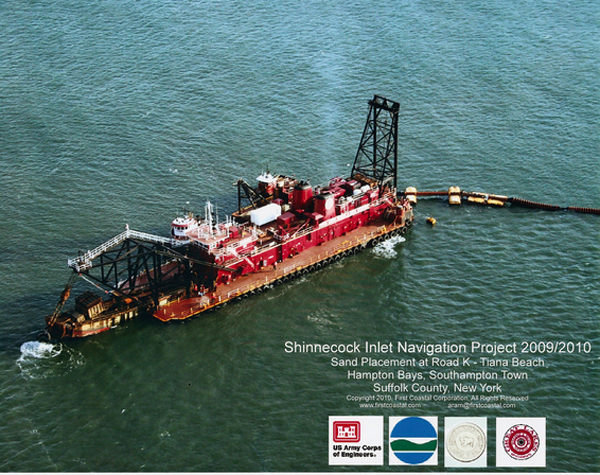
A contractor, Great Lakes Dredge & Dock Company, began dredging on December 7 after it was hired by the Army Corps of Engineers. In December, U.S. Representative Tim Bishop said he helped secure $11.72 million in state and federal funds for the project, but it ended up costing only $8.5 million, according to the Army Corps of Engineers.
Originally, the money that Mr. Bishop helped garner included $8.21 million in federal funds, $5 million of which was federal stimulus money, and $3.51 million in state funds. On Friday, January 15, the Army Corps of Engineers announced that they spent only $5.9 million in federal funds, $2 million of which was stimulus money, and $2.6 million in state funds.
“I think it’s great that it’s been completed on time and under budget,” Mr. Bishop said on Tuesday. “This is a very important project in terms of boater safety.”
He added that his office is conferring with the Army Corps of Engineers to determine if it could use the leftover funds for other projects in his congressional district, which includes both the North and South forks and all of Brookhaven Town. If not, the approximately $3 million will be returned to the federal treasury, he said.
At a press conference updating the progress of the project on December 18, Mr. Bishop credited Southampton Town Councilman Chris Nuzzi for originally pushing for the dredging project. Mr. Nuzzi said that shortly after he took office in 2006, local fishermen, including Mr. Horowitz of East Quogue, began telling him that the inlet was hazardously shallow.
“We became aware of the shoaling conditions that eventually became worse and worse,” Mr. Nuzzi said at last month’s press conference.
Mr. Nuzzi could not be reached for comment this week.
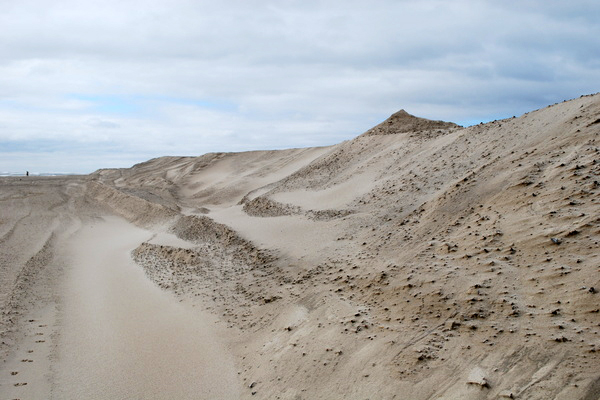
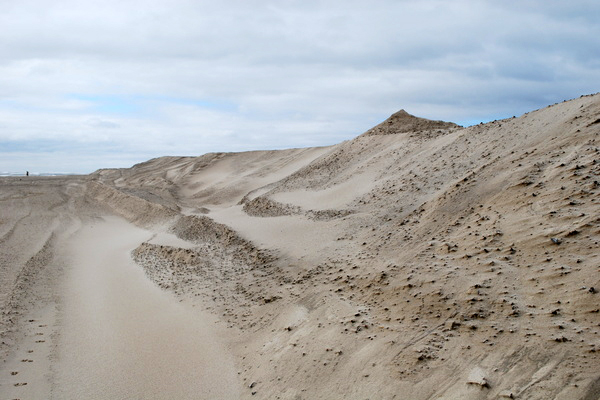
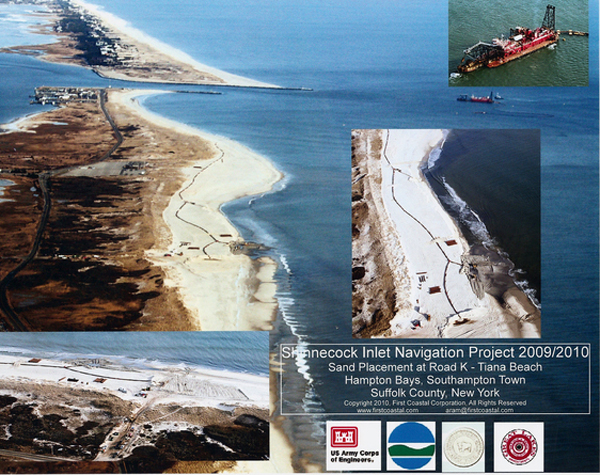
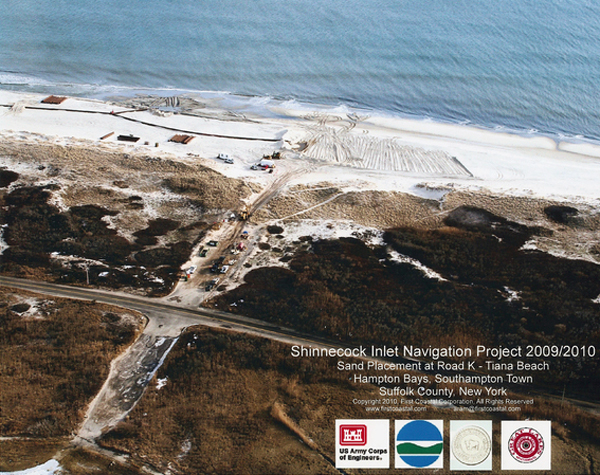
The sand that was drawn up from the channel’s floor over the past month was pumped directly onto Tiana Beach, about two miles to the west. Some of it was used to create a 70,000-cubic-yard emergency stockpile there for the state, county and local communities to use for future storm damage protection, according to the Army Corps of Engineers.
Despite delays caused by winter storms, workers on the Great Lakes Dredge & Dock Company’s vessel, The Illinois, managed to finish the dredging before the spawning season of winter flounder began last Friday, January 15. If they had missed the deadline, workers would not have been able to complete the dredging until the fall.
The dredging brought the depth of the inlet to about 22 feet. Before the work, the depth in the inlet varied between 7 and 18 feet, causing a hazard for boats that might run aground during low tide.
Furthermore, the shallow conditions caused waves to break farther off shore, which contributed to several vessels capsizing when they ran aground there in recent years, according to authorities.
An incident in March 2008 highlighted the dangerous conditions at the Shinnecock Inlet when a 45-foot commercial fishing boat, the North Sea, became grounded for more than three hours on a nearby sandbar, sustaining an estimated $15,000 in damage.
That incident followed a series of boating accidents near the inlet in 2005. On January 3 of that year, the Hail Mary II, a 62-foot steel-hulled dragger, capsized while carrying 40,000 pounds of squid near the inlet. On July 28, the Providence, a 47-foot dragger, also capsized and sank after being hit by a wave while trying to enter the inlet. And in April 2005, the 50-foot dragger Champion ran ashore on the beach in Southampton Village after a rope got tangled in its rudder while it was trying to enter the channel.
“It was getting really, really bad,” said Bob Soleau, who owns Soleau’s Wharf & Marina in Hampton Bays and near the mouth of the inlet, where many local fishermen unload their catch.
He explained that the approximately 35 commercial fishing boats that move through the channel year-round had adapted their practices to the dangerous conditions of the inlet. Some of the commercial vessels, which range from 35 to almost 100 feet and draw up to 14 feet of water, had to wait until high tide to come into port. Some fishermen would also cut their fishing time short because they were worried about entering the inlet during low tide.
“It was really a detriment for us not to be able to run through the inlet,” Mr. Soleau said, adding that the dredging project should be a boon for the local fishing economy. “It’s beautiful now.”
Now, the massive stockpile of sand on Tiana Beach rises above the dunes near Road K, off Dune Road. Municipalities in the area, including those that lost hundreds of thousands of cubic yards of sand in a powerful nor’easter that devastated the South Shore in November, will be able to use the stockpile to help reverse beach erosion.


 Will James on Jan 20, 2010