


 11 Photos



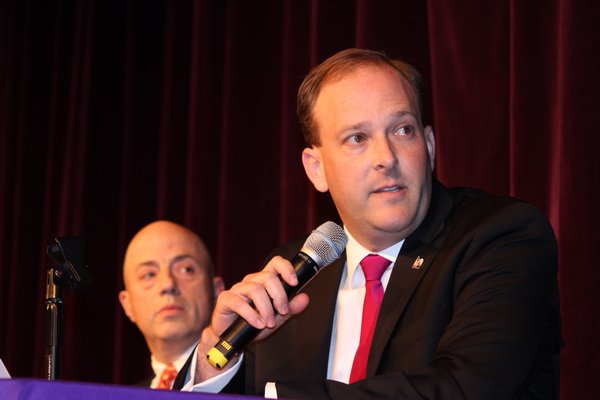
With one of the most contentious midterm congressional elections in decades just a week away, a raucous throng of supporters of U.S. Representative Lee Zeldin and his Democratic challenger, Perry Gershon, packed the Hampton Bays High School auditorium on Monday night for the only public debate between the two candidates on the South Fork this election cycle.
The candidates on Monday did not disappoint their supporters, trading barbs and challenging each other’s accounts of their own records throughout.
At Monday’s debate—and at a televised roundtable discussion with editors of the Press and Sag Harbor Express last week—the pair showcased the broad differences on a number of key issues.
Mr. Gershon, as he has done throughout the campaign, criticized the angry tone that his opponent’s advertising has taken and likened it to the approach President Donald Trump has applied to nearly every issue he has received push back on.
“My campaign has been based on issues and solutions,” Mr. Gershon said on Monday, repeatedly calling Mr. Zeldin a skillful performer who obfuscates his position with rhetoric and has relied on personal digs at Mr. Gershon since the day after the Democratic primary. “I’ve avoided personal insults and attacks throughout, because that is not the best way forward. We need to tone down the rhetoric throughout the country.”
Mr. Zeldin, for his part, focused on his “victories” for the East End and stood by his conservative stances on issues like immigration, health care, gun control and the recently spotlighted transgender rights, while highlighting Mr. Gershon’s New York City roots and his support for less stringent immigration enforcement.
“I’ve brought home a lot of important victories across the [1st District],” Mr. Zeldin said at the debate held at LTV studios on Thursday, October 25. “A picture of reality across our country today: to claim that our economy is not doing well, that MS-13 is not being defeated, that is just not reality.”
Just two days after the massacre at the Tree of Life synagogue in Pittsburgh, Pennsylvania, gun control took center stage early at Monday evening’s debate in a race that Mr. Zeldin said is the only one in the nation contested between two Jewish candidates.
Both men railed against burgeoning bigotry nationwide behind the massacre and others like it in recent years, calling for national efforts at tamping down emotions.
“The gun did not fire itself,” Mr. Zeldin said. “We have to address the hate that drove that.”
Mr. Gershon, who lives in East Hampton, was quick to call out statements made by President Trump that he said are “dog whistles” that encourage, unwittingly or not, strong emotions toward those one disagrees with.
“It’s an out-product of the poison rhetoric that is going on in this country,” he said. “That gives license to lunatics to come out and show their passion. We have to tone it down. It starts with the president.”
Mr. Zeldin replied by calling Mr. Gershon’s connecting the president to the Pittsburgh massacre “pretty outrageous.”
Mr. Gershon also said that Congress needed to find a way to impose new requirements on gun purchases, while preserving the right to bear arms.
“I support the Second Amendment, I support people’s rights to own a gun to protect themselves. I don’t want to take guns away from honest citizens—we have a right to protect ourselves, we have the right to hunt,” Mr. Gershon said.
“We should renew the assault weapons ban that expired in 2004. The AR-15 is a problem that should not be sold the way it is. And we should not have concealed carry reciprocity,” he added, referring to a bill supported by Mr. Zeldin, which passed the House, that would allow those with gun-carrying permits in one state to carry a concealed weapon in another, even if that state, like New York, has stricter rules.
Mr. Zeldin, who grew up in Mastic Beach, spoke only of legislation that addresses background checks to prevent suspected terrorists from purchasing guns, and said even that concern is not given enough attention by the Department of Justice.
But he seized on Mr. Gershon’s penning of an online statement about gun control in the wake of the Pittsburgh shooting as “politicizing the tragedy,” and his supporters personalizing it in their protests of his campaign.
“You haven’t even buried the people yet in Pittsburgh,” Mr. Zeldin said over a chorus of boos of Gershon supporters in the audience. “It’s important that we talk to each other, not past each other. Showing up at my office holding up a sign that has my daughters’ names on it, talking about someone shooting them, doesn’t help.”
Throughout the debate, Mr. Gershon focused on Mr. Zeldin’s siding with or lack of push back against President Trump on a number of hot-button issues.
He linked the incumbent to the rolling back of funding for the Environmental Protection Agency and the weakening of air quality protections by the Trump administration. Mr. Zeldin, in turn, said that EPA funding to projects in New York’s 1st Congressional District had increased during his tenure, and he noted that the Long Island Sound Program, the National Estuaries Program and Sea Grant, a federally financed marine research and education program, had all been fully funded in the most recent federal budget.
Mr. Zeldin acknowledged that he had supported the president’s decision to remove the United States from the Paris climate accords, saying that the United States was making costly concessions, while other countries were increasing their carbon emissions.
He also blasted Mr. Gershon for railing against the president’s East Coast offshore oil drilling proposal—which he too has opposed—while owning stock in oil industry companies. Mr. Gershon said the company he had invested in owns a harbor facility where oil tankers unload oil to shore, but has nothing to do with offshore drilling, as his opponent has suggested.
On health care, the pair reiterated their well-staked-out differences. Mr. Gershon called for shoring up and supporting Obamacare and for the nation to start working on a single-payer system that has come to be referred to as “Medicare for All.”
“We need universal health care,” he said. “We’ve come a long way. We can’t be going backward.”
Mr. Zeldin said that Obamacare has been more of a hindrance than a benefit for New Yorkers and has been a disaster in some states, where insurance companies have left markets altogether rather than try to comply with the law’s requirements.
“I don’t agree with ‘Medicare for All,’” he said. “Nobody has figured out how to pay for it. I don’t want a single-payer, government-controlled health care. That is not in the best interests of my constituents.”
On immigration, Mr. Zeldin said that he supports expanding legal immigration and lifting caps on visas, but that he also thinks border security needs to be strengthened, including the president’s marquee issue of building new hardened barriers along portions of the border where there are none now. He also said he favored more funding for Border Patrol and Immigration and Customs Enforcement.
Mr. Gershon called the idea of a border wall “a myth” and said that what is needed is comprehensive, bipartisan changes to immigration laws and that the policies of the Trump administration have pushed immigrants “into the shadows.”
At the televised discussion in Wainscott last Thursday, Mr. Gershon had said that Mr. Trump’s knee-jerk reaction and sensationalist moves to put immigration in the spotlight were detrimental to level-headed legislation on the topic.
“Trump’s response is to send troops, not lawyers, to look at the cases,” he said of the much publicized caravan of immigrants from Honduras walking north through Mexico, and the president’s threats of cutting aid to that country in punishment.
“We should be looking at making conditions better in Honduras, not cutting aid. That’s going to make more people try to leave Honduras. It’s backward.”
Mr. Zeldin said that he has been critical of the president’s rhetorical posturing with regard to immigration, but also said that the idea of a caravan of people pushing toward the U.S. border is disturbing.
“We should not allow them to roll over us,” he said. “You have to deal with it directly, and you have to be aware that people are watching.”


 on Oct 30, 2018