


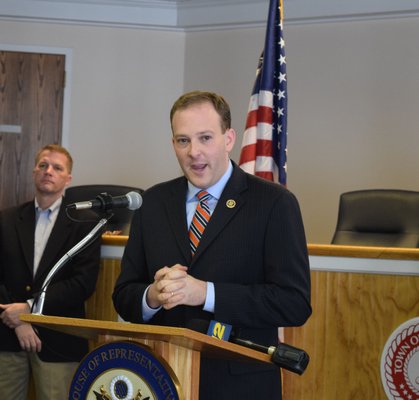
 1 Photo
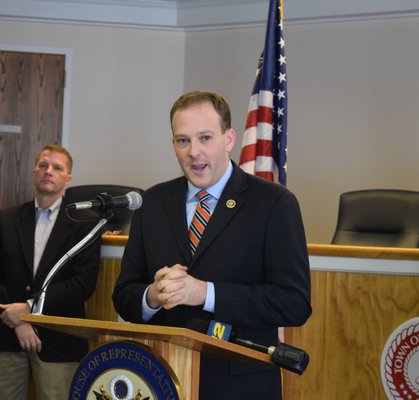
Gun control is regularly a key issue in federal races, and it figures to be a prominent issue in fall election campaigns in the wake of ISIS-inspired shootings in the United States and attacks around the world.
Representative Lee Zeldin, who faces his first run for reelection in November, has come under fire from his Democratic opponent, Anna Throne-Holst of Noyac, for his stance on a proposal to bar the sale of guns to those on an FBI watch list of individuals who are deemed sympathetic to or engaged with terrorist groups.
But the freshman Republican says that his own bill—and a broader security proposal that includes similar language on gun sales currently being considered by the House of Representative—takes what he believes is a fairer approach to background checks, while still blocking those feared to be connected to terrorism from purchasing firearms.
Mr. Zeldin has criticized the efforts of a fellow Long Island Republican, U.S. Representative Peter King, who introduced a bill last year that would bar anyone on the federal “no-fly” list, or the broader terrorist watch list, from purchasing a firearm. The bill has not been brought to a vote of the full House by Republican leadership because of resistance to it from Mr. Zeldin and other Congress members who have raised concerns that the watch lists are too arbitrary and inaccurate.
“The proposals that were out there [in 2015] put the burden on the purchaser to prove that they are not a terrorist,” Mr. Zeldin said. “I just believe the burden should be on the government to prove that someone is a potential terrorist.”
Mr. Zeldin said earlier this summer that the terrorism watch list has been shown to be unreliable and often in error, and has often included American service members, citizens and even toddlers with names similar to those suspected of terrorist ties.
A Senate bill that would have barred anyone on the FBI watch list from purchasing a gun was voted down by the Republican majority in June, just a week after the Orlando massacre, and Democrats blocked another Senate bill that added to the instant background check system but did not support a more comprehensive background check effort.
Mr. Zeldin has introduced a measure he has dubbed the “Protect America Act” that would allow the FBI to halt a gun purchase for up to 72 hours if a name on one of their lists shows up in the federal instant background check database as someone suspected of terrorism ties. Lawyers from the Attorney General's office would then have to take evidence of their suspicions to a judge to get a more permanent block on the sale.
The heart of his proposal was woven into H.R. 5611, a broad Homeland Security bill addressing feared gaps in the national security net to prevent terrorist attacks. Both bills would allow five-year background checks to see if a would-be purchaser had previously been on the watch list. Such a retrospective search would have blocked Omar Mateen, the Florida man who killed 49 people in an Orlando nightclub with a legally purchased assault rifle, from buying any guns.
“The goal here is to prevent a terrorist from being able to purchase a firearm,” Mr. Zeldin said, “but to do so without violating due process rights or Second Amendment rights of law-abiding Americans. The fact is, there is a way to do it. So it is important to not settle for anything less.”
Mr. Zeldin has said that the tweaks to terrorism watch list restrictions are not just a matter of protecting the Second Amendment rights of law-abiding gun buyers. Allowing the automatic background check system to halt a purchase could compromise FBI investigations of suspected terrorists, Mr. Zeldin noted, by tipping off would-be terrorists to the fact that they have been spotlighted as suspicious.
Ms. Throne-Holst has blasted Mr. Zeldin for months over his stance, saying that he has effectively voted against measures that would keep guns out of the hands of self-proclaimed terrorists like Mr. Mateen.
“Lee Zeldin has voted repeatedly against Congressman Peter King’s bill that would stop suspected terrorists from buying guns, and is supported by chiefs of police,” she said in a recent statement. “Lee Zeldin’s sham alternative would make Americans less safe and fail to close this dangerous loophole.”
She has called for the restrictions proposed by Mr. King to be adopted, along with other “common sense” measures regarding background checks and restrictions on sales of certain kinds of guns, like assault rifles.
Critics have noted that background checks of almost any kind are easily avoided at largely unregulated gun shows and through online purchases—another point that Ms. Throne-Holst and other Democrats have criticized Republicans over.
Local gun sellers have acknowledged the loose restrictions on sales in other parts of the country, but note that New York State’s background check system is already one of the most robust in the nation.
“We have such strong laws [in New York] that it’s very difficult for someone who shouldn’t have a gun to get one legally,” said Frank Dalene, whose Bridgehampton store, Survivability Services International, is one of the only two retail gun sellers remaining on the South Fork. “In New York State, we have it pretty under control.”
Bill H.R. 5611 was taken up on July 1 by the House Rules Committee, where it will be debated when Congress returns from its summer recess.


 on Aug 2, 2016