



 4 Photos


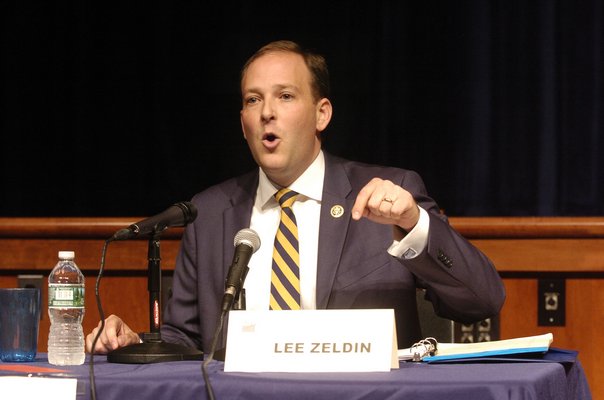
As his Republican colleagues in Congress pore over and tinker with the legislation they are pushing as an alternative to the existing Affordable Care Act, U.S. Representative Lee Zeldin said this week that he supports the core principles of the GOP legislation thus far and thinks it won’t have some of the impacts on seniors and the less affluent, at least locally, that many have said it will.
The reception to the latest attempt at health care guidelines has been tepid at best. Government analysts have said the Republican alternative to the ACA will mean as many as 24 million fewer people will have health insurance nationwide within a decade.
But the bill maintains some of the most popular provisions of Obamacare, like allowing children to remain on their parents’ family health plans until age 26, and not allowing insurance companies to deny coverage for pre-existing conditions. It also would reduce the federal deficit by $337 billion through 2026, according to a Congressional Budget Office report.
The bill does allow companies to charge up to 30-percent higher premiums for one year to those individuals who did not previously have health insurance, an approach intended to dampen the losses for insurance companies when some people seek insurance only after finding out they are sick and cannot be denied coverage.
Critics have panned the direction the legislation is heading in as a tax cut for corporations and the wealthy, and an approach that will mean higher costs for senior citizens. Radio ads began running last week that stamped the legislation as including an “age tax” on an aging population.
Mr. Zeldin said that, at its heart, the Republican bill seeks primarily to eliminate government mandates that Americans must have health insurance.
He said the plan aims to protect insurance coverage for those who desperately need it, incentivize more young people to buy it and bring down costs for everyone involved. But he has said in interviews and in mailings to constituents that the bill is expected to lower premiums over time.
The Congressional Budget Office has said that in the long run the bill would keep premiums about 10-percent lower than they would be if the ACA were left in place, but has not said that premiums will actually decline.
The end of the mandates, Mr. Zeldin fully acknowledged on Friday, is the main reason the CBO and other analysts have said that the number of insured people nationwide will drop by 14 million people or more nationwide in the first year that the Obamacare requirements are lifted. The CBO estimates that the number could rise to 24 million by 2026—mostly due to individuals opting to not carry health insurance.
“That’s one of the realities—if they aren’t forced to, some people will chose to not buy health coverage,” the congressman said. “But those are important principles, which I agree with—I don’t support the ACA individual mandate and employers mandate.”
Mr. Zeldin said that while the GOP plans would roll back the federal subsidies that helped states expand their Medicaid programs, those who have received Medicaid under Obamacare would not suddenly see their benefits yanked away. The current legislation, he said on Friday, would continue the federal contribution to Medicaid through 2019, and anyone who is enrolled before then would continue to receive a subsidy even after the federal plan halts new support.
Numerous nonpartisan groups that have reviewed the plan have said that some Medicaid recipients—about five million nationwide, according to an estimate by the Kaiser Family Foundation—would lose coverage immediately simply because states would not be able to maintain the programs that had allowed them to qualify for Medicaid for the first time under the ACA.
For seniors, the congressman said, the GOP plan would not be an “age tax,” as the most dramatic criticisms have said. He touted the age-graded tax credits the bill offers, which go up with age, and said that, in New York at least, the pairing of state law and the federal tax credits would be a boon for seniors. But premiums for older citizens have been forecast to go up steeply under the new plan, because it reduces limits on how much insurance companies can raise rates for their older, more illness prone, customers.
Mr. Zeldin also defended the bill against those painting it as a tax cut for the wealthy, saying the GOP approach simply removes all the mandates and tax penalties in the ACA—which includes mandates and penalties on corporations and very wealthy individuals. He noted that the proposal leaves the so-called “Cadillac tax,” an additional tariff scheduled to go into effect in 2020 on the most robust and expensive health care plans. The Republican bill delays implementation to 2025.
But health care analysts also note that the GOP plan delays some taxes on high-priced health plans and relies heavily on increasing the amount of before-tax deductions an individual can take for putting income into dedicated medical care funds—to as much as $13,000, levels that most say would only be fully exploited by the wealthy.
Mr. Zeldin has been highlighting in interviews, and in an email to constituents last week in support of the health care legislation, that the CBO has forecast that premiums under the Republicans’ approach would decline by 10 percent by 2026.
“As far as costs go, the CBO scoring has premiums reducing between now and 2026 by an average of 10 percent,” Mr. Zeldin told The Press in a phone interview on Friday morning. “That’s pretty outstanding.”
But the CBO report itself seems to say only that premiums would be 10 percent less than projections of premiums if the current law remained in place over that time period.
Mr. Zeldin noted that his party’s proposal on health care is still evolving, almost daily, and will likely go through a number of tweaks before coming to a vote in the House, and even more before the Senate could approve its own version. As the current legislation is merely a budget-based reconciliation bill, the long-term vision of improving health care coverage would still have future legislation on tap.
“This is one step of a three-step process,” Mr. Zeldin said. “The second step will include administrative actions at the executive level, and third would be new legislation. I’m hoping that as these steps are completed, we are moving to a better reality that has more affordable choices with higher quality coverage.”


 on Mar 21, 2017