


 1 Photo
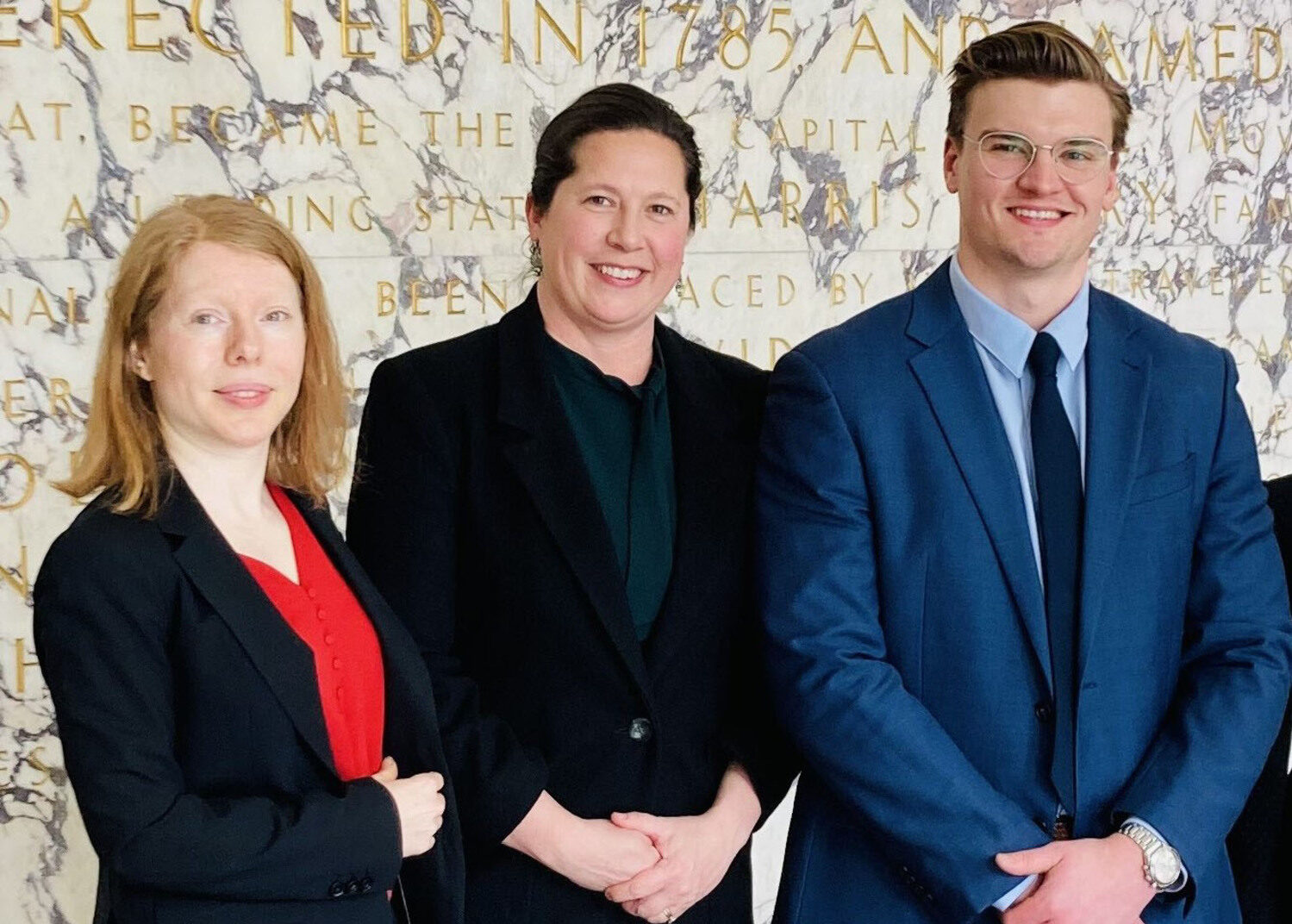
Managing Attorney, Local Journalism Project Cornell Law School First Amendment Clinic Heather E. Murray, left with with co-counsel Paula Knudsen Burke of the Reporters Committee for Freedom of the Press and Clinic alum Connor Flannery, who argued in the Pennsylvania Court of Common Pleas, Dauphin County in February 2023 in a case seeking access to sealed settlement agreements on behalf of local journalism client The Patriot News/PennLive. Courtesy Heather E. Murray
Municipalities throughout New York State are still grappling with the use of videoconferencing for public meetings, both by voting members of boards and by the public attending those meetings.
The law changed significantly during the COVID pandemic, and Governor Kathy Hochul, in this year’s recently approved state budget, extended the measures enacted during the pandemic through 2026.
To clarify what the state law currently says about the use of videoconferencing at public meetings, we turned to Heather E. Murray, the managing attorney of the Cornell Law School First Amendment Clinic’s Local Journalism Project. A former journalist herself, her work includes representation of journalists and news outlets in litigation and counseling and training on nonlitigation matters. She is a member of the advisory committee of ProJourn, a pro bono initiative housed at the Reporters Committee for Freedom of the Press.
The interview — conducted by videoconference — has been lightly edited and condensed.
Q: Prior to COVID, what were the rules in place for how technology could be used for people to attend meetings, as participants on a board or as a member of the audience?
Prior to COVID, and going back all the way to 2000, there was a provision of the Open Meetings Law that allows for videoconferencing. But it only allows for videoconferencing from public locations. So you could connect two different physical locations that are public — that’s been in the law for a long time. I think it was underutilized because of the fact that it needed to be public locations.
Q: So, a lot of times, with boards here, somebody will be in Florida, for instance, in the offseason, and they will log in via the internet to be part of a meeting through videoconferencing.
That doesn’t count — because for that, if you wanted that to count, you’d have to put on the public notice the location and make it open to the public.
Q: So that person who’s in Florida would have to be —
Would have to open their home to the public if the public wanted to go. Frankly, I just personally don’t think you’d really count that anyway. Who’s going to travel to Florida for it?
… But when it happened during the pandemic, when things were entirely remote, there was a period of time during COVID when there was an executive order that just suspended the in-person requirement altogether.
Q: So, during COVID, in those cases, those requirements would be waived, and you were able to —
Correct. That was waived during that. There was an executive order first issued by [Governor Andrew] Cuomo and then extended by Hochul. It went into 2022.
Then you have the current rules, that you were just talking about, that were issued in 2022.
Q: Okay. So the 2022 rules lifted waiving those rules, correct?
Correct.
Q: So the old rules came back into effect.
Correct. So you have the old rule for videoconferencing, but then you also now have this new rule that requires an “extraordinary circumstance” in order to participate remotely. That’s the new rule that started in 2022 and has now been extended for another two years. It’s extended through July 1, 2026.
Q: I see. So to be clear, before COVID you couldn’t do that.
Correct. I know this is very confusing.
Q: This is exactly why I wanted to have this conversation, because I think a lot of boards are dealing with this right now. So, post-COVID, now the new rule is “extraordinary circumstances” allow board members to join by videoconferencing and take part in that meeting?
Yeah. You still have that other rule, which allows, if they’re public locations, you can still do that, too. So, there’s two different rules. If there’s two public locations, you can have videoconferencing.
But the one that people are really focused on is this “extraordinary circumstance” one — which it’s not defined clearly in the law, as you know. It’s been left up to municipalities to issue written procedures as to what is defined as an “extraordinary circumstance.”
But it does say directly in the Open Meetings Law: It’s disability, illness, caregiving responsibilities, or any other significant or unexpected factor.
I do know the Committee on Open Government has heard from a number of people, and they issued a statement about this in their most recent annual report, that people would like that in-person quorum requirement, the burden of that, to be lessened. Because I think they’re having difficulties with getting board members all there. It might be in part because they got comfortable with not having to be in person during the pandemic. It might be in part because workplaces are going hybrid. It’s just becoming a new reality.
Q: The various municipalities, I think, are dealing with setting those rules now. Southampton Village is having that conversation now, as a matter of fact. So because the “extraordinary circumstances” isn’t really defined, they have a lot of latitude in making that decision. Do they each have to make a decision about what is “extraordinary circumstances”? Do they have to define that individually?
They do have to issue written procedures as to how they’re going to enforce this provision. So that, to me, would include defining what an “extraordinary circumstance” is. As you know, with any definition, you’re going to have case-by-case circumstances where you’re going to have to decide, is this an extraordinary circumstance or not?
Q: Is this just for elected boards or is this also for regulatory boards that are appointed? Do these rules apply to all of those boards as well? Zoning boards, planning boards?
Yeah. This applies to all public bodies that are subject to the Open Meetings Law.
Q: Okay. So what about audience attendance? A lot of the boards during COVID held meetings via videoconferencing that people could join. Some of the boards have continued to do that even as they went back to live meetings: They also stream those meetings and allow people to attend that way. What’s the law now, as far as that goes? Do boards have to do that? Do they have the option of doing that? How does that work?
So, they’re not generally required to livestream, but if you’re using this “extraordinary circumstance” provision that we were just talking about, then you are required to provide a link in the notice where the public can attend remotely. So that’s now a requirement, if they’re going to take advantage of that circumstance.
Certainly, there’s been push from a number of good government organizations to just make livestreaming a requirement right across the board, which, as you and I sitting are here today, we can think of lots of reasons why that would be a good thing.
I think there’s been push-back, particularly from areas of the state with more limited broadband, that they would need some subsidy or something in order to make that a reality. But you would certainly think that that’s the way the public meetings should be going toward, should be going toward hybrid, in my view — hybrid, where you have an in-person option for those who would like to attend in person, but you can also attend remotely if that’s your preference.
Q: True or false: My local board held these meetings on video during COVID, so they’re required to continue doing them on video now?
It depends. But, false, if it’s only for that reason.
Q: They’re not required to continue.
They’re not required. But if they’re going to take advantage of this “extraordinary circumstance” provision and certain members are going to attend remotely through that provision, then, yes, then they do need to.
Q: Can you talk a little bit about the philosophy behind this? Why does it matter whether board members attend in person or by video link? Why does it matter whether audience members are allowed to be there live or by a video link? What’s the philosophy behind this?
I think this goes to the philosophy behind open meetings laws in general. That it’s essential to democracy. That public businesses should be performed in an open and public manner. That citizens need to be fully aware of and able to observe public officials in the performance of their public duties.
The reason for the videoconferencing, and, during videoconferencing, having the opportunity to speak if you were otherwise able to speak in a public in-person meeting, for a similar reason that citizens have the right to attend and to listen to the deliberations and decisions that go into the making of public policy and to participate in that decision-making.
Q: If you were giving advice to boards, would it be to be more liberal with the use of videoconferencing for all these purposes, especially for allowing people to attend the meetings?
Definitely. I think for all the reasons that we just discussed. Also, you have a number of members in the community who are disabled and wouldn’t otherwise be able to attend a meeting.
I think most boards, I would say, throughout the country have seen a marked decline in recent years in people attending meetings in person. Many boards reported a significant increase in that attendance when folks were able to attend remotely.
Q: What’s the climate in New York State? Through the First Amendment Clinic, are you hearing about problems with any of this statewide? Complaints, people complaining about how boards are handling this particular issue?
Yeah, I’ve heard more confusion than anything else. Confusion about how to implement this because of the various changes that have taken place over the last few years.
Q: So everybody’s in the same boat trying to figure all this out, basically.
I think that’s right. And you’re going to help them!


