


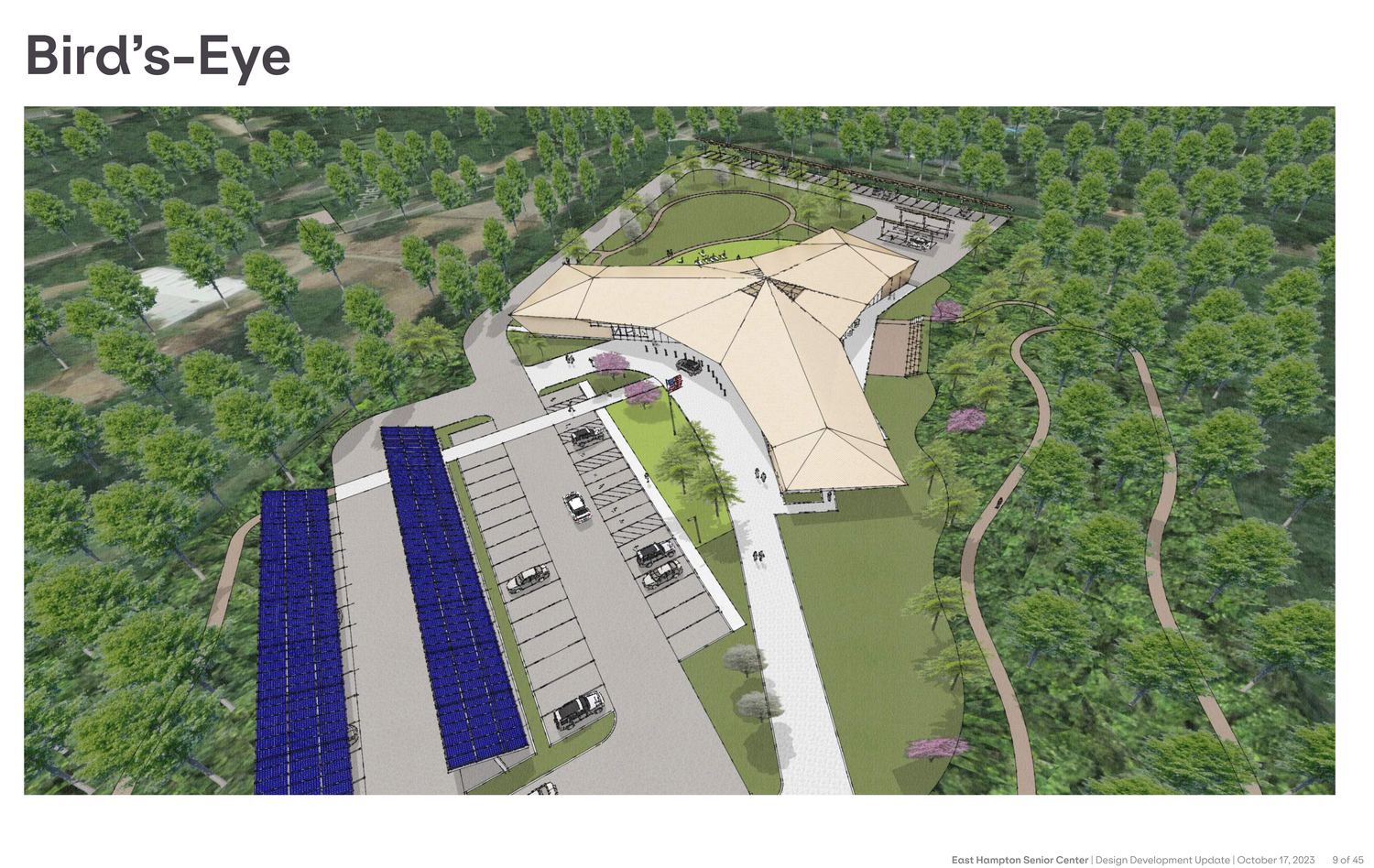
 3 Photos
Construction of the new East Hampton Town Senior Center will get underway in early 2024 and is expected to be completed by the end of 2025.
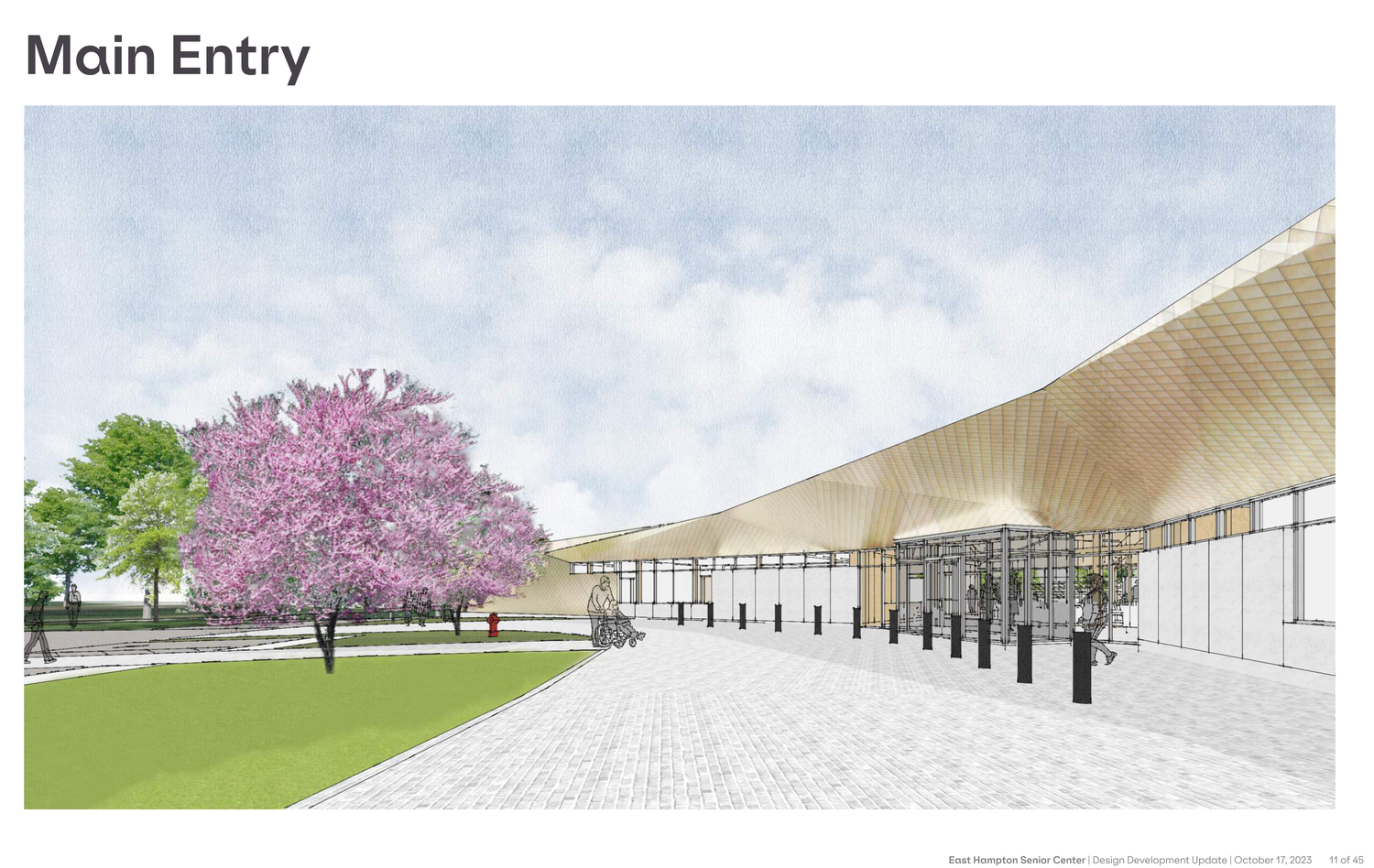
Construction of the new East Hampton Town Senior Center will get underway in early 2024 and is expected to be completed by the end of 2025.
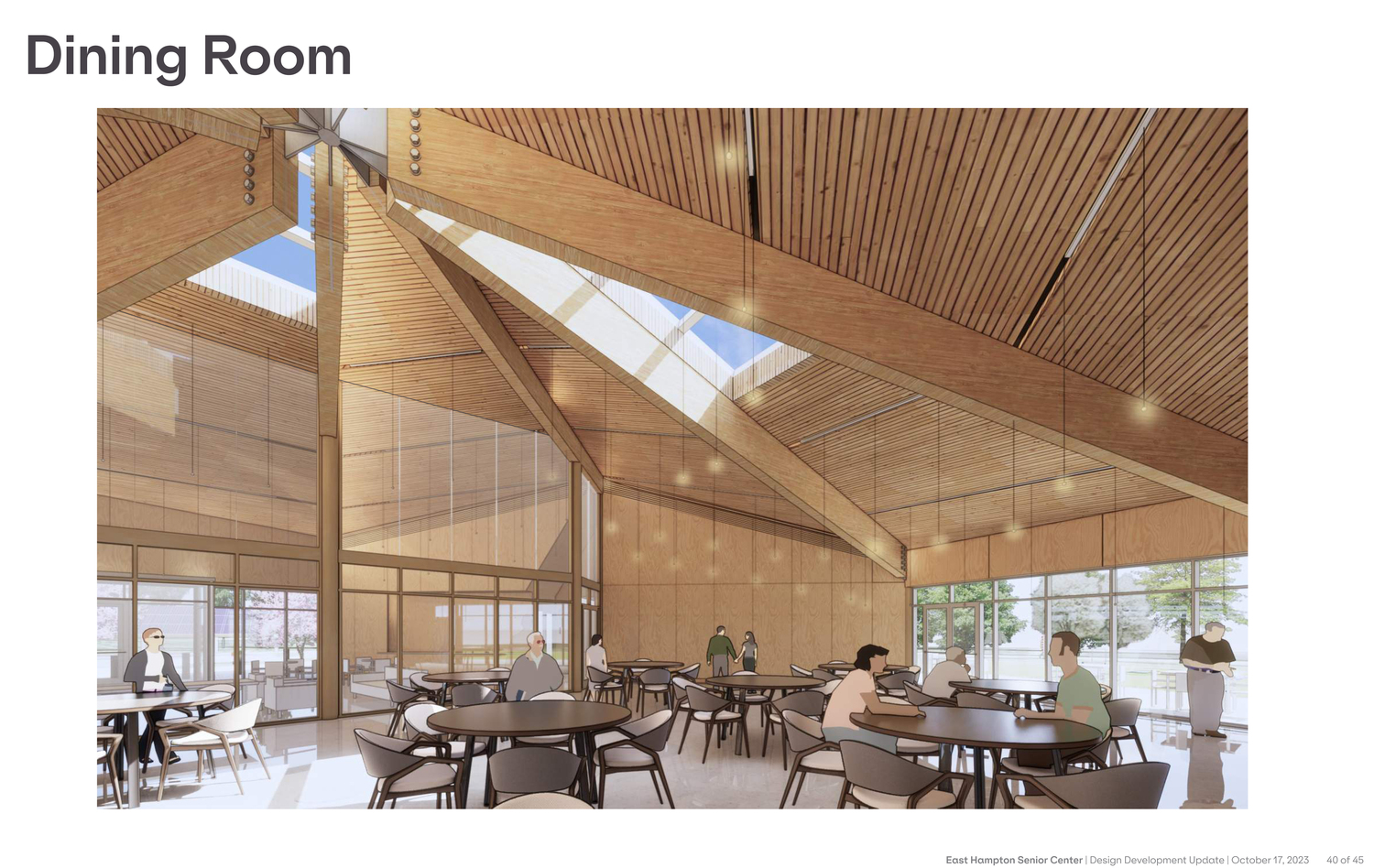
Construction of the new East Hampton Town Senior Center will get underway in early 2024 and is expected to be completed by the end of 2025.
East Hampton Town expects to begin clearing land off Abrahams Path in January to make way for the start of construction of the new East Hampton Senior Center.
The architects who are designing the building presented the Town Board with detailed plans for the new facility — featuring sloping rooflines reminiscent of a potato barn, stainless steel shingles, and skylights that are able to capture energy while allowing sunlight into the building’s central spaces — and said they hope to have the building under construction by the second half of next year and completed by late 2025.
The designs have yet to be finalized — or priced — and the town’s Planning Board and Architectural Review Board are still to be consulted on the layout and design. But the construction site and access road must be cleared by the end of February, after which cutting down trees is prohibited until the following November to protect endangered long-eared bats.
The group said they expect to complete the final steps of the design choices, which will include the all-important construction cost forecasts, and have environmental assessments and formal plans ready to present by early next year, in the hope of getting the proposal through the various steps of review by late spring or early summer so that the approximately 18 months of construction can get underway.
Councilwoman Kathee Burke-Gonzalez, who has shepherded the project, said during Tuesday’s Town Board meeting that the clearing would be done in two phases, the first one this winter, to get trees that can’t be cleared after March removed so that the site can be accessed when the construction plans are finalized and approved and the project is ready to begin. Then additional clearing of the land for the work can be done.
A traffic study has been completed and town staff is working on an environmental assessment of the project to present to the Planning Board, which she said will be asked “for comment” on the project. Town-sponsored development projects do not technically have to be formally presented to the Planning Board for regulatory review — although the town has done so with its recent affordable housing projects.
Architects Ronnette Riley and Carol Ross Barney and their team from R2 Architects have been working for more than a year on the designs of the new facility, a long-needed replacement for the undersized and deteriorating center on Springs-Fireplace Road.
Charged with creating a building that would serve the social, nutrition and wellness programs that the town’s Human Services Department provides currently, along with an ambitious view of expanding services as the town’s senior population grows, and the town’s desire to see a “net zero” carbon-neutral facility, has presented a high bar for the architects.
“It’s been such a delight to work with this team — it’s been a tremendous collaboration,” Burke-Gonzalez said. “It’s coming to life.”
The R2 team spent much of last year in engagement sessions with current seniors and town residents whose family, or they themselves, will be using the faculty in the coming years, and the staff of the current facility, working through the needs and logistics of the new building.
Exercise and ample wellness program spaces, outdoor activities, workshops and social gathering spaces focus around food and coffee offerings had topped the list of amenities the users and staff of the current facility had asked the architects to incorporate.
Earlier this year, the town settled on a layout the architects call “the windmill” — its three wings jutting outward from a central atrium resemble a windmill’s blades and hub — because of its open and airy layout that keeps the most used spaces in the building near the front entrance to minimize walking distances, while allowing for offices and other programming spaces to be both separate and near the center.
The commercial kitchen, at the rear of the building, will service both the daily dining hall meals as well as “grab-and-go” meals prepared for seniors who will be able to drive up to a door off the kitchen to grab prepared meals, in addition to the meal delivery service that Human Services provides to homebound seniors.
Burke-Gonzalez said the team is still going over the designs for the kitchen — which pose the most daunting energy usage hurdles for the net zero goal — with Human Services staff and energy experts to find energy savings wherever possible, while still providing the food prep facilities the center will need.
The kitchen will use electric induction stoves and a geothermal heating and cooling system — a costly addition — so that no fossil fuels will be directly needed to operate the building.
Board members said they were happy with the designs with only scattered hesitation, mainly about the proposal for stainless steel shingles, and suggested tweaks.
“I really appreciate the soaring feeling you get when you walk in, and the lightness coupled with the warmth of the wood,” Councilwoman Sylvia Overby said. “And I appreciate all the sustainability.”
“I think you really captured the community engagement, which I was a part of,” Councilwoman Cate Rogers added. “The form meets the function so well. There’s a lot of connectivity. I’m still not sold on metal shingles, but I’m open.”
“I’m looking forward to metal shingles,” Town Supervisor Peter Van Scoyoc, who is retiring at the end of the year, responded. “I’m also personally looking forward to taking advantage of the senior center in 2026.”
The town has been wrestling with plans for the new center since 2018, when its initial plan to build anew on the current site was derailed by legal and logistical hurdles, followed by a nearly two-year search for a suitable new site on which to build.
The town purchased the 7-acre property, adjacent to the town ballfields on the east side of Abrahams Path, in 2021 for $1.63 million.
What the proposed facility would cost has not yet been discussed. The town set a budget of $10 million for the project in 2021, though how rising construction costs or the ambitious designs might impact that forecast is not known. The town has greatly reduced its debt load in recent years, despite boasting the vaunted Aaa credit rating that would bring it bargain basement interest rates on loans. The town also has a robust capital reserve of more than $60 million on hand.
“At this point, we’re looking at timeline and cost — those are the big questions that are still out there,” Van Scoyoc said, and urged the team to expedite getting the property cleared this winter so that the construction schedule would not be threatened with months of additional delay. “It’s import we start doing the site work. It’s the only window we have.”


 Michael Wright on Oct 18, 2023